
WEEKLY NEWSLETTER
Get One Good Result Before You Automate It

© CURRENT YEAR, AI Business Lab. All rights reserved.
Don’t start AI workflow automation until you have one result you’d sign off on.
Last weekend, my daughter Mary came over, and we built an Instagram carousel skill. The job was to turn her Fathom coaching-call transcripts into posts, and we made a separate visual brand guide to go with it.
We locked in a couple of rules. First, her photos get used as supplied, and AI never regenerates her face. Second, AI never includes client information. This is not about the specific client; it’s about the lesson or the framework Mary shared with the client.
The output improved, but she still rejected several slides. So I told her to keep iterating.
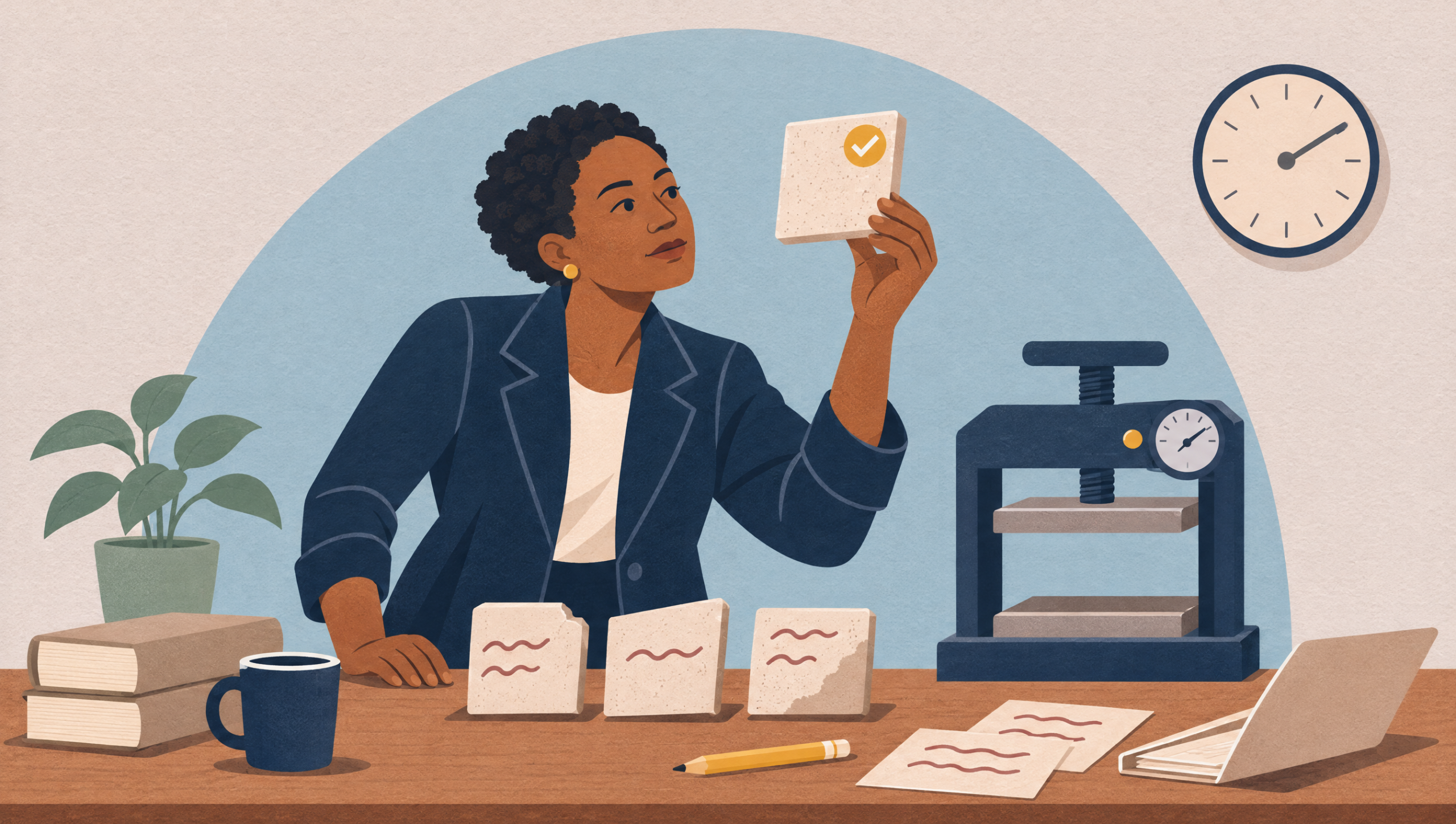
This is often the missing step in creating Standard Operating Procedures. We try to create them too soon. Instead, we should manually iterate until we get the output exactly like we want it. Then—and only then—do we commit it to a skill.
A skill is like an SOP for agents or bots. Think of it as a workflow: here’s what you do first, second, third, and so forth.
The benefit is much like delegation. Once we invest the time to train an employee how to do something, we get the return on that investment for a long period of time.
We don’t have to keep recreating the wheel. Once we dial in the skill and it reliably produces the output we want, we enjoy the fruit of our investment.
You can build a skill you’ll actually trust by following four steps. That holds whether you save the finished process as a Grok Bot Skill, a Claude Skill, or a ChatGPT plugin. The tool comes last. The result comes first.
You’ve probably already heard of skills. You may even have created a few. The part that’s easy to miss is getting one good result before you start AI workflow automation.
Step #1: Pick One Real Job
Don’t start by writing the playbook. Start with a job you already do, the way Mary and I started with her carousel posts.
Pick something that repeats, such as a weekly report, a client recap, or a short post built from a call transcript. If you can’t point to a real piece of work, you’re inventing a process in the abstract, and you’ll lock in a guess.
Researchers following senior creatives for a year have described what happens when AI makes an early idea look finished too soon. In one case, a client approved a campaign image before production could test it. The lighting was impossible to recreate on a real set. 1
The image looked done. It wasn’t. That’s the same risk you run when you write the playbook too soon.
Step #2: Iterate Until It’s Right
Now do the work with AI, and stay in the loop. This is the longest step, and it’s the one that determines whether the skill is worth saving. As AI makes a polished draft easier to get, the hard part is knowing what to trust, what to question, and what to refine. 2
This is where tenacity becomes a superpower. Don’t give up until the output is exactly the way you want. Keep iterating until the AI gets it right—just like an employee you were onboarding.
As I write this, Mary still isn’t finished. She spent hours on the design today, and she told me, “It still cannot get the design right.” She’s keeping at it anyway. She keeps reminding herself, “It would take at least a month to train a new employee.”
Someone will object that iterating by hand is slower than just automating. Of course it is, in the first session. So is training a new employee for a month, and you would still do that before you put them on their own. The first slow pass is what makes every later pass faster.
You’ll know the output is right when it meets a simple test. A result that only works once, or only after you clean it up, is not ready to save. Check for these three things:
- You would use this version without edits.
- It follows your rules every time.
- It holds up when you try it on a different input.
Tell the model what it missed, ask for another version, and compare it with the last one you almost accepted. Stop only when you would put your name on the result.
Step #3: Have the AI Capture What It Learned
You don’t have to write every correction down as you go. The AI is already tracking what happened in the conversation.
Once the output is right, stay in the same conversation. The key is to prompt the AI to take everything it’s learned in the interactions and iterations with you and turn that into a skill.
This is the step most people skip. They iterate until the result looks good, then they close the tab. The learning stays in the chat instead of becoming a skill.
Step #4: Commit the Finished Process to a Skill
When the output is right, save the process as a Grok Bot Skill, a Claude Skill, or a ChatGPT plugin. I wrote about how to create a Claude Skill earlier this year, in “Claude Skills: The Feature That Makes Claude 10x Smarter.” That piece will get you from a tested process to a skill you can reuse.
Pick the destination that matches how you already work. What matters is that you are saving a process you have already proven.
If you skip that, you will freeze a half-finished method and then run it faster. Decades ago, Michael Hammer warned leaders not to “pave the cow paths.” Companies were using new technology to speed up old processes instead of fixing them first. 3
Save the skill only when it is a record of what already works. Then you can let it run.
Start With One Job
Imagine next month, when that same job shows up again. You don’t start from scratch. You start from a skill that already does the work the way you want it done.
You don’t have to automate the whole company this week. You only have to get one job right and save the process. That’s a small experiment you can start today. Open the last job that still takes too much effort, and work it through by hand first.
What’s the one result you still need to get right before you turn the process into a skill?
Comments
If you have a question about getting one good result before you automate it, click here to send me an email. I read every one. Seriously. Your experiences help me write better content, and sometimes the best insights come from readers like you.
Transforming AI from noise to know-how,
P.S. Consider the AI Business Lab Mastermind: Running a $1M+ business? You’re past the startup chaos but not quite at autopilot. That’s exactly where AI changes everything. The AI Business Lab Mastermind isn’t another networking group—it’s a brain trust of leaders who are already implementing, not just ideating. We’re talking real numbers, real strategies, real results. If you’re tired of being the smartest person in the room, this is your new room. 👉🏼Learn more and apply here.
REFERENCE
- Jana Retkowsky, Ella Hafermalz, Marleen Huysman, and Daan Odijk, “Research: Gen AI Is Collapsing Creative Processes,” Harvard Business Review, September 16, 2026. ↩︎
- David S. Duncan and Tyler Anderson, “Help Employees Get Better—Not Just Faster—with AI,” Harvard Business Review, June 15, 2026. ↩︎
- Michael Hammer, “Reengineering Work: Don’t Automate, Obliterate,” Harvard Business Review, July–August 1990. ↩︎