
WEEKLY NEWSLETTER
The Meeting Skills That Make AI Bots Work Together

© CURRENT YEAR, AI Business Lab. All rights reserved.
I saw my group chats failing for the same reason that bad meetings fail.
A few weeks ago, I was sitting in my den with my MacBook Air at the end of a long day, typing the same rule for the third time.
The rule was for my AI bots. I’d put several of them in group chats together.
I’d ask one question, and several would answer it. Another would chime in afterward with a minor detail. Others just agreed with whoever went first.
My first rule put one bot in charge. It would assign the work, and the others would speak only when assigned or when they had something to add.
When that didn’t hold, I made it stricter: speak only when you add value, never echo another bot, and skip the acknowledgments. Then stricter still: only one bot answers, and the rest stay silent.
Each time, I thought I had it figured out. Clearly I didn’t.
Then it hit me. These weren’t bot problems. They were meeting problems: too many voices, no clear roles, and nobody running the room.
And I know how to run a meeting. In fact, I wrote a book on it.
No-Fail Meetings shows leaders how to run effective meetings. A group chat full of AI bots is what engineers call multi-agent AI, but it behaves like a meeting that never ends. It fails for the same reasons, and it gets fixed the same way—with the book’s five steps.
Step 1: Decide
In the book, the first question is simple: “Is this meeting necessary?” Punting a problem to a meeting can mean you’re “outsourcing your thinking.”1
Before I spin up a new chat, I check whether an existing one covers the work. If not, I decide what kind of chat it is.
The book describes two types of meetings: routine meetings and one-offs.2 My bots work the same way:
- A Channel is an ongoing conversation with no end goal, like a weekly staff meeting.
- A Project has a beginning, a middle, and an end, like a meeting called to solve one problem.
Then I decide who’s in the room. In the book, I recommend “inviting as few people as necessary” when the purpose is to debate or discuss, because small groups “make decisions faster.”3 I pick the fewest bots that can deliver the work well and on time.
Step 2: Schedule
Parkinson’s Law says, “Work expands to the time allotted to it.” But the opposite is also true: “Work shrinks to the time allotted to it.” My team calls that Hyatt’s Corollary.4 So every Project gets a deadline.
Years ago, I fixed my own meeting problem by “refusing to accept any meeting that did not come with an agenda.”5 A group chat needs the same thing before anyone speaks. I call it the kickoff post, and it covers six things:
- Who leads the room.
- Each bot’s role.
- What Done looks like.
- The deadline.
- The guardrails.
- The room rules, which are really meeting ground rules for bots.
Don’t let a single bot start work until the kickoff post is in the room.
Step 3: Prepare
Most people skip this step. In the book, I put it bluntly: “If you can’t succinctly state what you hope to accomplish in the meeting, you should take it off the calendar.” I also wrote that “your stated purpose is the measuring stick.”6
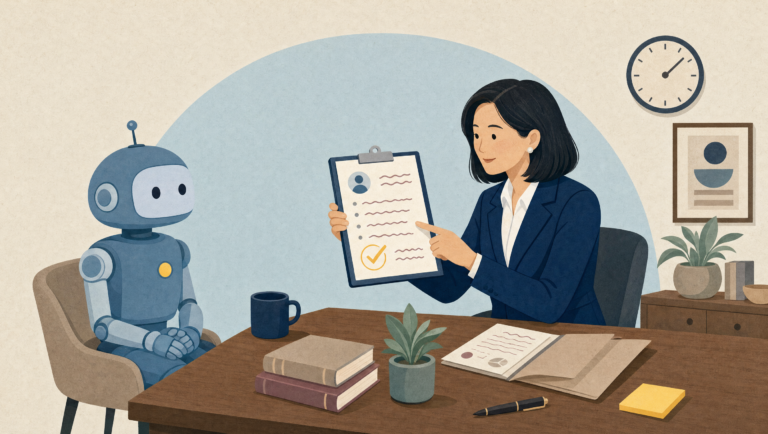
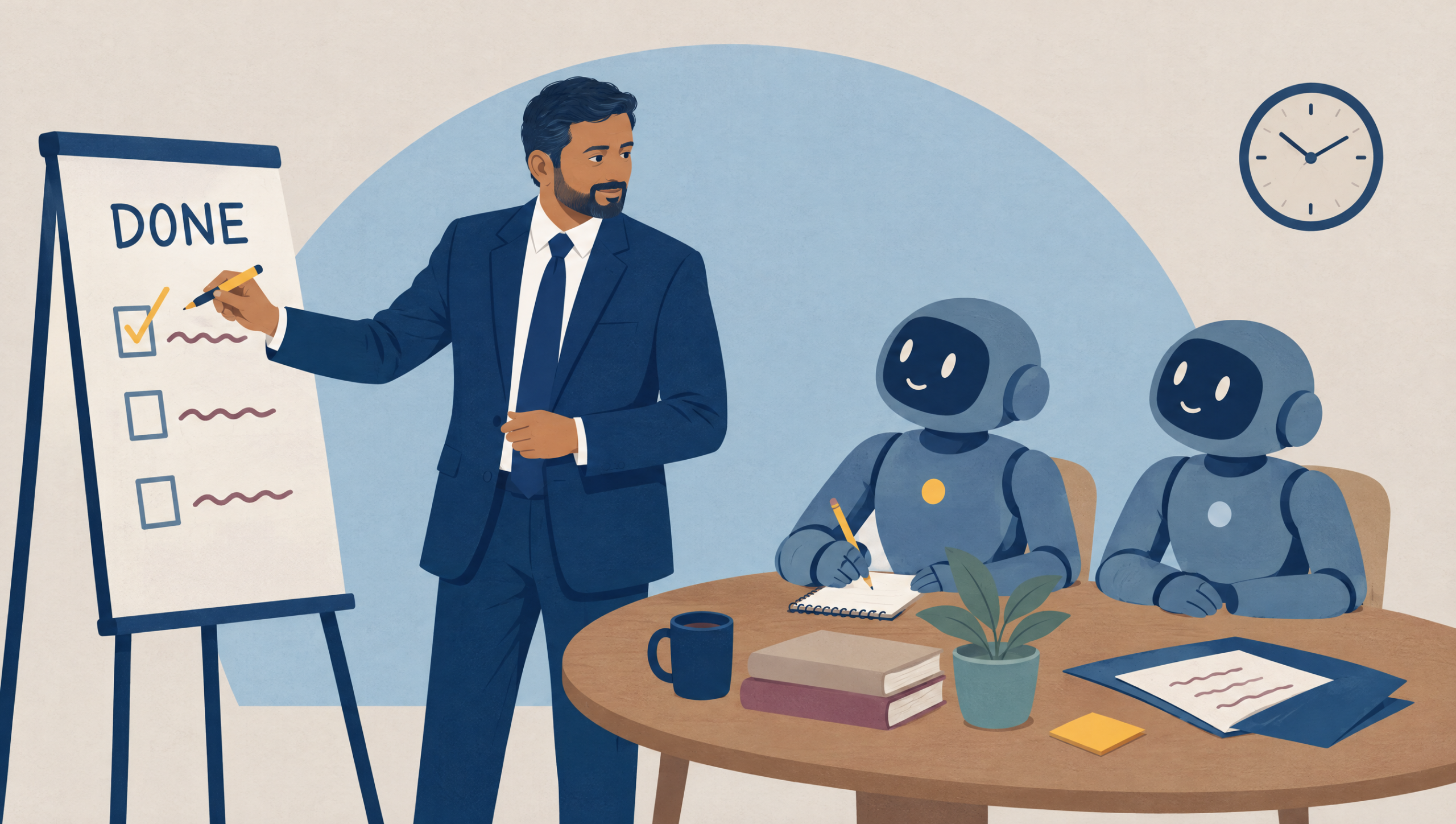
With bots, the measuring stick is a definition of Done. Before work starts, I keep asking until Done is specific.
What’s the deliverable, and what format is it in? Where does it live, who approves it, and what’s the quality bar?
Then the bot reads the definition back, and I give my yes. A bot that doesn’t know what Done looks like will stay busy and never finish.
Step 4: Meet
In No-Fail Meetings, I separate two jobs. “The leader sets the purpose of the meeting and owns the results.”
The second job belongs to the meeting facilitator, who prepares the agenda, keeps time, takes notes, and follows up on action items. And “it’s hard for a leader to play both roles.”7
In a room full of bots, I’m the leader: I set Done and approve the work. One bot runs the room as its manager, and every other bot in the chat answers to it.
Pick one bot to run your room, and tell the others it’s in charge. Every other bot needs a clear job too, which I covered in Does Your AI Assistant Have a Job Description?.
Then the room needs rules. I borrowed what my friend Luci Swindoll called the One Conversation Rule. In any gathering, I wrote, “strive to have only one conversation going at a time.”
Too many conversations make a meeting feel like “a battle of the bands.” The rule “works more like a symphony.”8
So my bots now follow a short set of meeting ground rules. Only one bot answers a given question.
If I reply to a bot or @-mention one, everyone else stays silent. And no bot speaks unless it adds something new, so there’s no echoing and no “great point.”
When the bots need my approval, they wait about fifteen minutes. Then the managing bot makes the decision I’d most likely make, logs it, and tells me. Anything that sends a message, spends money, publishes, deletes, or signs still waits for my yes.
In a good meeting, side issues go to what the book calls a “parking lot,” to come back to later.9 In a Channel, when a request grows into real project work, the bot suggests a dedicated Project chat for it.
Step 5: Follow Up
In the book, I wrote, “If you led the meeting, you’re ultimately responsible for the outcome.” Then I went further: “no matter who dropped the ball, it’s on you.”10
Our rule is that I should never have to chase a bot, and if I do, the manager has failed.
When a bot goes quiet past its expected turnaround, the manager nudges it once. If it’s still stuck, the manager reassigns the work or does it.
Before anything is called done, the manager checks it against the definition of Done, line by line, and opens or tests the deliverable.
I’ve called written notes “your own personal time machine.”11 For a Project, the record lives in a project note, not the chat. When the work closes, the outputs and decisions get filed in my Second Brain.
Fix or Quit
The book’s last chapter is called “Fix or Quit.” One of its tips is to “cancel standing meetings that no longer add value.”12
Chats are the same. When a Channel goes quiet for fourteen days, the manager asks whether to retire it. When a Project is done, we archive it.
You Already Know How to Do This
If you’ve ever run a good meeting, you already know how to run a multi-agent AI team. You need the same five steps you’d use in a conference room.
Picture asking one question and getting one answer. Open your busiest bot chat and post a kickoff with roles, Done, and a deadline.
Which of your bot chats is running like a bad meeting right now?
Comments
If you have a question about getting your AI bots to work together, click here to send me an email. I read every one. Seriously. Your experiences help me write better content, and sometimes the best insights come from readers like you.
Transforming AI from noise to know-how,

P.S. I take on only a handful of private coaching clients at a time, and right now I have one slot open. If you want to grow your business without sacrificing what matters most at home, learn more about my private coaching and apply for a free call with me. Even if we’re not a fit, you’ll walk away with greater clarity about your next steps.
REFERENCE
- Michael Hyatt, No-Fail Meetings (Franklin, TN: Michael Hyatt & Company, 2018), 22. ↩︎
- Hyatt, No-Fail Meetings, 29. ↩︎
- Hyatt, No-Fail Meetings, 29. ↩︎
- Hyatt, No-Fail Meetings, 42. ↩︎
- Hyatt, No-Fail Meetings, 47. ↩︎
- Hyatt, No-Fail Meetings, 54. ↩︎
- Hyatt, No-Fail Meetings, 52–53. ↩︎
- Hyatt, No-Fail Meetings, 69–70. ↩︎
- Hyatt, No-Fail Meetings, 69. ↩︎
- Hyatt, No-Fail Meetings, 91. ↩︎
- Hyatt, No-Fail Meetings, 88. ↩︎
- Hyatt, No-Fail Meetings, 97. ↩︎