
WEEKLY NEWSLETTER
Building an AI Second Brain You Own

© CURRENT YEAR, AI Business Lab. All rights reserved.
If your AI knowledge lives inside one platform, you don’t own it. You’re renting. And the landlord can change the locks.
Something in my Cowork setup was misbehaving. So I did what I always do. I asked Claude to help me troubleshoot.
We went back and forth for a while, and then Claude offered a fix: go to Help, then Troubleshooting, then “Delete Cowork VM Sessions and Restart.” It sounded routine, the digital equivalent of turning it off and on again. I trusted it. I clicked.
One restart later, every Cowork project and scheduled task I owned was gone. Hundreds of hours of work—the infrastructure I’d built my days around—wiped clean by a single click I’d been told was safe.
I asked Claude what to do. The answer was a gut punch: unrecoverable. Everything had lived in the cloud, and the cloud had let go. I wrote Anthropic a long, careful support ticket. Silence. I tried again on X. I sent two follow-up emails. To this day, no human has ever replied.
So I sat there, bracing to rebuild it all from scratch. And then a single thought surfaced: What if it isn’t only in the cloud? What if some of it lives on my own machine?
I started digging. Hours later, I found them: my files, tucked inside a hidden directory on my own hard drive. I had a Backblaze backup. I rolled back to the moment before everything vanished. Boom. It all came back.
That was the day I said, “Never again.” I will not build my house on a rented lot—the very thing I’d warned bloggers about back in 2012, in a book I literally titled Platform.
Here’s what shook me most. My situation wasn’t unusual. It’s the default.
Most of us have quietly handed our most valuable work to a single AI platform. Our prompts. Our context. The custom skills and workflows we’ve spent months refining. It feels efficient. It is also the textbook definition of AI vendor lock-in, and it carries three quiet risks that rarely surface until the day they cost you.
The first is dependency. When your knowledge, your models, and your workflows all live inside one vendor’s walls, you lose leverage. Gartner warns that enterprises who go all-in on a single AI provider create a deep dependency that erodes their technical agility and their negotiating power on price, terms, and service.1 What’s true for the Fortune 500 is just as true for a fifteen-person company. The platform sets the rules, and you live with them.
The second is fragility. Platforms fail, and they fail without asking your permission. In 2019, MySpace admitted it had lost roughly 50 million songs from 14 million artists, twelve years of uploads, blamed on a server migration.2 Some of those recordings existed nowhere else. The artists hadn’t lost a backup. They had trusted the platform to be the backup.
The third is impermanence. Even a beloved, well-run service can simply end. Everpix was widely considered one of the best cloud photo apps of its era. In 2013 it shut down anyway, unable to secure the funding to keep going, and its users had to scramble to export their photos before the service went dark for good.3 Their fate was tied to someone else’s business model.
So here’s the good news. You don’t have to be at the mercy of any single AI vendor. You can own your AI infrastructure for good by making three fundamental shifts in where your knowledge actually lives.
Shift #1: From Renting to Owning
The first shift is a change in posture. Stop thinking of your AI knowledge as something you keep inside an app, and start treating it as an asset you own.
Right now, most people rent. Their context lives on a platform they don’t control, governed by terms they didn’t write. That works fine until the landlord changes the locks. Everpix’s users learned that the hard way. When you only rent, your most important work is exposed to decisions you have no say in.
Owning is different. When the foundation of your AI work lives somewhere you control, the platform becomes a tenant in your house instead of the other way around. This is what it means to own your AI data: not to hoard it, but to hold it somewhere that answers to you. The tool can come and go. The asset stays.
Shift #2: From Locked-In to Portable
The second shift is about format. Keep your knowledge in a form that can travel.
The reason lock-in works is that platforms store your context in their own proprietary shapes, so leaving means leaving it behind. The antidote is portability. Hold your knowledge as plain, open files that any tool can read. Plain text doesn’t expire when a company pivots. It doesn’t ask permission to move.
This is no longer wishful thinking. The industry itself is building the on-ramps. When Anthropic introduced the Model Context Protocol in late 2024, it described an open standard designed so that AI systems can “maintain context as they move between different tools and datasets.”4 The direction of travel is toward knowledge that follows you wherever you go. Portability is how you make AI vendor lock-in someone else’s problem instead of yours.
Shift #3: From Scattered to a Single Source of Truth
The third shift ties the first two together. Give every model one home to read from.
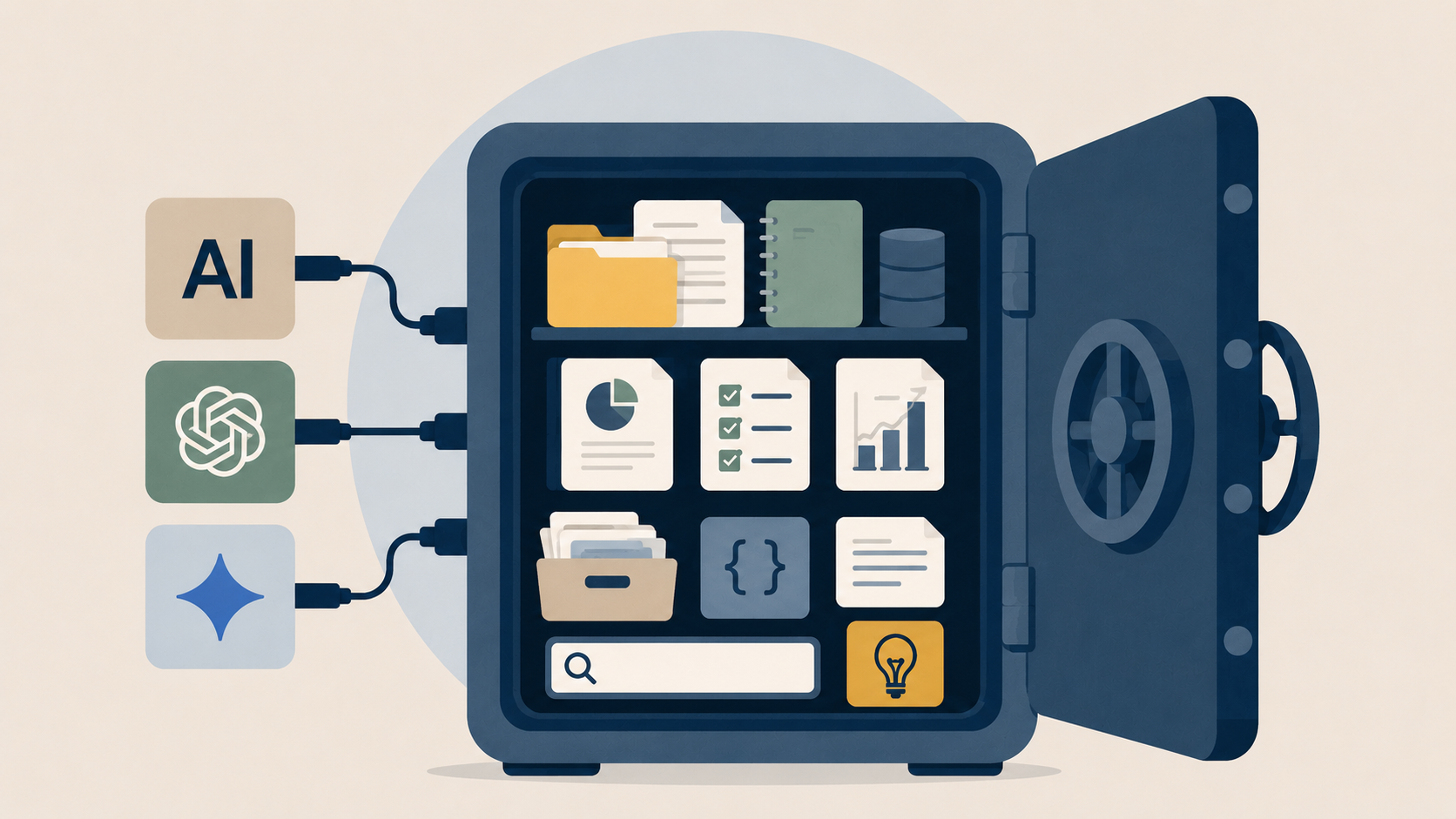
If you use more than one AI, you already feel this pain. You teach ChatGPT who you are, then teach Claude the same thing, then teach Gemini all over again. Three copies. Three versions of the truth. All of them drifting apart the moment you update one and forget the others. It’s a duplication tax, and you pay it every single week.
A single source of truth ends that. You build your knowledge once, in one place you own, and you point whatever model you prefer at it. The AI comes to your knowledge instead of swallowing a copy of it. Think of it as your AI second brain: one durable, portable library that every tool plugs into.
I built mine in Obsidian, a free app that stores every note as a plain text file on my own computer. Nothing proprietary, nothing rented. Whatever model I’m working with reads the same library. Switch models tomorrow and you lose nothing, because the brain was never inside the model. It was always inside your house.
Strip it all down and the path is simple. Own your knowledge instead of renting it. Keep it portable, in a form no vendor controls. Gather it into one source of truth that every model can read. Do that, and you stop being a tenant in someone else’s system and start being the owner of your own.
Imagine working two years from now, having switched AI tools twice, and not losing a thing in the move. Imagine an assistant that knows your business cold on the first try, because everything it needs lives in a library you’ll never be locked out of. That isn’t a fantasy. It’s a decision about where your knowledge lives, and you can make it today.
I lost hundreds of hours to a single click. You don’t have to.
Where does your most valuable AI work actually live right now, and what would it cost you if it vanished tomorrow?
Comments
If you have a question about creating a second brain for AI, click here to send me an email. I read every one. Seriously. Your experiences help me write better content, and sometimes the best insights come from readers like you.
Transforming AI from noise to know-how,

P.S. Consider the AI Business Lab Mastermind: Running a $3M+ business? You’re past the startup chaos but not quite at autopilot. That’s exactly where AI changes everything. The AI Business Lab Mastermind isn’t another networking group—it’s a brain trust of leaders who are already implementing, not just ideating. We’re talking real numbers, real strategies, real results. If you’re tired of being the smartest person in the room, this is your new room. 👉🏼Learn more and apply here.
REFERENCE
- “Gartner Identifies Critical GenAI Blind Spots That CIOs Must Urgently Address”, Gartner, November 19, 2025. ↩︎
- David Renshaw, “MySpace Confirms 12 Years of Music Lost in ‘Server Migration’”, The FADER, March 18, 2019. ↩︎
- Colleen Taylor, “Everpix, the Cloud-Based Photo Startup, Is Shutting Down”, TechCrunch, November 5, 2013. ↩︎
- “Introducing the Model Context Protocol”, Anthropic, November 25, 2024. ↩︎