
WEEKLY NEWSLETTER
Your AI Org Chart Is Finally Here

© CURRENT YEAR, AI Business Lab. All rights reserved.
You ask one bot, copy its answer to another, check the result, and restart the thread. You’re not leading AI work. You’re routing it.
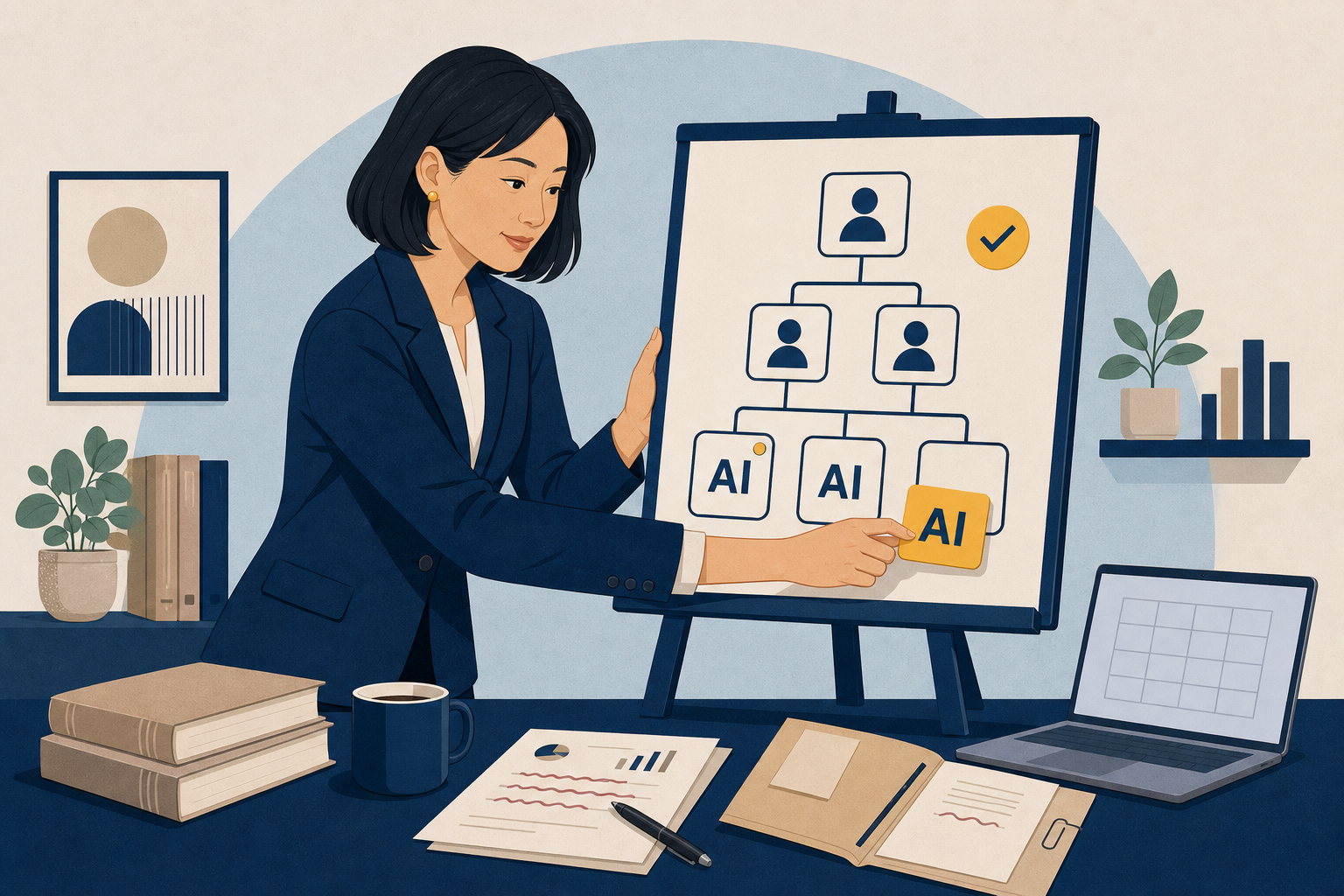
In September 2025, at our first AI Business Lab Mastermind, I put up a slide from my talk on the future of AI. It was my company’s org chart. Some of the boxes had human names. Some had agents. I told the room, “This is the future.” It landed.
The chart was a metaphor, and the tools weren’t there yet. Most of us were still living in a chat window, asking and answering. AI could research and write with me in the room. It couldn’t do work while I was away.
So I went looking. Late in 2025 and early in 2026 I tried OpenClaw and wrote about why most owners shouldn’t install it yet.1 Single-agent platforms came next, Claude Cowork first, then ChatGPT, Hermes, and Runner, and my output jumped. On March 26, 2026, Greg Isenberg’s Startup Ideas episode on Paperclip gave me a real eureka.2 I tried it. Too hard for the people I serve.
Then this summer, over a few weeks, Buzz showed up, then Grok Bot, then Hermes Bot Mode. For the first time, the technology matched the chart on that slide.
I now run fourteen named bots. I talk with them all day, and somewhere along the way the line between teammate and tool began to blur. I didn’t decide to stop noticing it. It just stopped asking to be noticed.
You can stop serving as the router for every AI task by making four SHIFTS from lone-agent sessions to a persistent multi-agent platform. The goal isn’t a more crowded dashboard. It’s an operating model in which work has owners, handoffs, guardrails, and continuity.
Shift #1: From Disposable Chats to Named Teammates
A disposable chat begins with an empty box. You provide the context, explain the assignment, correct misunderstandings, and carry the useful output into the next conversation. When you return, much of that setup begins again.
A named teammate starts from a defined role. It has a purpose, responsibilities, working instructions, access to relevant resources, and a recognizable place in the organization. Naming helps you and your human team know who owns what.
That means organizing agents around durable responsibilities rather than temporary prompts. One might own customer research. Another might prepare a weekly operating brief. Another might review marketing assets against the company’s messaging standards. The assignment persists even as individual tasks change.
This is where an ai agent platform begins to resemble an organization. The agents aren’t interchangeable text generators. They become distinct points of responsibility that can collaborate on a persistent cloud computer, retain their working environment, and return with completed work or approval requests.3
Start with your recurring workflows. Ask, “What work repeatedly comes back to me because nobody else clearly owns it?” That question will usually reveal the first useful agent roles. Give each role a defined outcome, relevant context, and boundaries. You’re designing seats before assigning work.
Shift #2: From Manual Routing to Structured Handoffs
Most AI-assisted businesses still rely on the owner as dispatcher. An agent produces research, but you must copy it into another window. A second agent drafts a plan, but you must explain the original objective again. A third reviews the plan, but only after you notice that review is needed.
A multi-agent platform changes the flow by making handoffs part of the workflow.4 The research agent can pass its findings to the strategist. The strategist can produce a brief for the writer. The reviewer can evaluate the draft against predefined criteria and return either requested changes or an approval recommendation.
Good handoffs require structure. Each agent should know what it is receiving, what outcome it owns, what standards apply, and where its completed work should go. A useful handoff includes the original objective, relevant source material, decisions already made, unresolved questions, and the expected deliverable.
That structure keeps context from degrading as work moves. You can inspect the workflow, see where work is waiting, and intervene when a genuine judgment call appears.
This is the difference between using several AI tools and building an AI workforce platform. The value comes from coordinated movement. Work advances through a designed system rather than a series of isolated conversations.
Shift #3: From Constant Oversight to Defined Approvals
Delegation breaks down when every action requires permission. It also becomes reckless when nothing does. The practical middle is a clear approval architecture.
You should decide which actions an agent may complete, which actions it may prepare but not execute, and which actions always require human judgment. Internal research may proceed freely. A customer-facing message may need review. A financial commitment, personnel decision, or public statement should usually remain behind a human approval gate.
Grok Bot, for example, lets agents complete jobs independently, then return when approval is required.5 That lets you supervise at decision points instead of watching every intermediate step.
Approvals should be attached to risk, not habit. If you review every paragraph out of habit, the system never matures. Defined brand standards, escalation triggers, and acceptance criteria let the agent handle routine quality control and surface exceptions.
The platform should also make status visible. You need to know what is active, what is blocked, what awaits approval, and what has finished. Visibility creates confidence because autonomy is easier to grant when progress can be inspected.
The result is accountable leverage. Agents receive room to operate, while consequential decisions remain where they belong. Your job shifts from monitoring activity to setting standards and resolving exceptions.
Shift #4: From Open-Window Work to Persistent Progress
Chat-based work usually stops when you close the window. Persistent agents can continue inside an ongoing environment, collaborate with other agents, finish assigned jobs, and come back when they need input.6 That changes the practical relationship between you and AI.
You can assign an outcome, leave the workspace, and return to progress rather than potential. Research may be gathered, source material organized, a draft prepared, and a review completed before you reenter the workflow. The workday no longer depends on continuous prompting.
Persistence still needs durable roles, accessible resources, explicit completion conditions, and a defined route for escalation.
This builds on the agent-team model I described in “How to Turn Your AI Agents into a Team”.7 The next step is to place that team inside a shared multi-agent platform where responsibilities, handoffs, approvals, and progress can continue without you coordinating every move.
The four SHIFTS reinforce one another. Named teammates create ownership. Structured handoffs create flow. Defined approvals create safe autonomy. Persistence creates momentum beyond the open window.
That is the larger opportunity. With thoughtful design, AI becomes part of your company’s operating capacity, extending your reach without requiring your presence at every step.
The org chart I showed in September 2025 was once a metaphor. Now it can become a management choice.
Which recurring responsibility are you ready to give a named AI teammate?
Comments
If you have a question about building a multi-bot org chart with named AI teammates, click here to send me an email. I read every one. Seriously. Your experiences help me write better content, and sometimes the best insights come from readers like you.
Transforming AI from noise to know-how,

P.S. Consider the AI Business Lab Mastermind: Running a $1M+ business? You’re past the startup chaos but not quite at autopilot. That’s exactly where AI changes everything. The AI Business Lab Mastermind isn’t another networking group—it’s a brain trust of leaders who are already implementing, not just ideating. We’re talking real numbers, real strategies, real results. If you’re tired of being the smartest person in the room, this is your new room. 👉🏼Learn more and apply here.
REFERENCE
- “Don’t Install OpenClaw Yet—Here’s Why”, AI Business Lab, March 31, 2026. ↩︎
- Greg Isenberg, “Paperclip: Hire AI Agents Like Employees (Live Demo)”, The Startup Ideas Podcast, March 26, 2026. ↩︎
- “Grok Bot overview”, xAI Docs, September 3, 2026. ↩︎
- “Bot Mode”, Hermes Agent Docs, September 4, 2026. ↩︎
- “Grok Bot overview.” ↩︎
- “Grok Bot overview.” ↩︎
- “How to Turn Your AI Agents into a Team”, AI Business Lab, August 18, 2026. ↩︎