
WEEKLY NEWSLETTER
How to Turn Your AI Agents into a Team

© CURRENT YEAR, AI Business Lab. All rights reserved.
Your AI workforce needs an org chart before it needs another agent.
In 1986, I’d just started a publishing company when I read Michael Gerber’s The E-Myth. It felt like discovering the key to building a profitable, sustainable business. I still recommend it today.
One lesson stuck: build the org chart for the company you intend to become, not the one you have. You have to know what you’re building toward before you decide who fills which seat. Stephen Covey said the same thing a different way: begin with the end in mind.1
Forty years later, I had to relearn it for AI.
I’d created several AI agents, but I couldn’t tell you how they fit together. Their roles blurred. Without a distinct mission or qualification, each one still felt like a machine, and I was still the one deciding who did what and chasing every handoff myself.
So I asked AI directly:
Based on what you know about me and my work, how should I staff my agent workforce to accelerate and complete my goals?
The answer came back as an org chart.
A chief of staff sat beneath me. Specialists in research, editorial, marketing, technology, and finance filled in around that seat. Then I gave each agent an avatar, a name, a title, a professional history, and the chart stopped being a diagram. It became a team.
I stopped seeing machines. I started seeing coworkers.
Whether you already have several AI agents or none yet, you can design a workforce that fits your business. Four decisions get you there.
Decision #1: Start With the Outcomes You Want
Start with the tools, and you’ll build the wrong workforce. You keep adding promising agents until you’re staring at a crowded toolset and no coherent team.
Start with the business instead. What are you trying to accomplish? Where does the important work stall because nobody has the time, focus, or expertise to own it?
Maybe you need faster research, a steadier content pipeline, better financial visibility, or tighter follow-through. Each answer points to the help your business needs.
Gerber’s principle still holds. An org chart is more than a record of who you have today. It’s a visual expression of your strategy: the functions, responsibilities, and relationships required to build the business you envision.2
Write down three to five outcomes that matter most over the next year. Then ask, “What work must happen consistently for us to achieve these outcomes?” Your answers reveal the functions your AI workforce should support.
Decision #2: Design Roles Around Those Outcomes
Once you know the work that matters, turn each recurring responsibility into a role. Give it a title, a mission, an area of ownership. Then define the qualifications it needs.
I put a chief of staff directly beneath me to coordinate priorities, then added specialists for research, editorial, marketing, technology, and finance. Each role ties back to an outcome I care about.
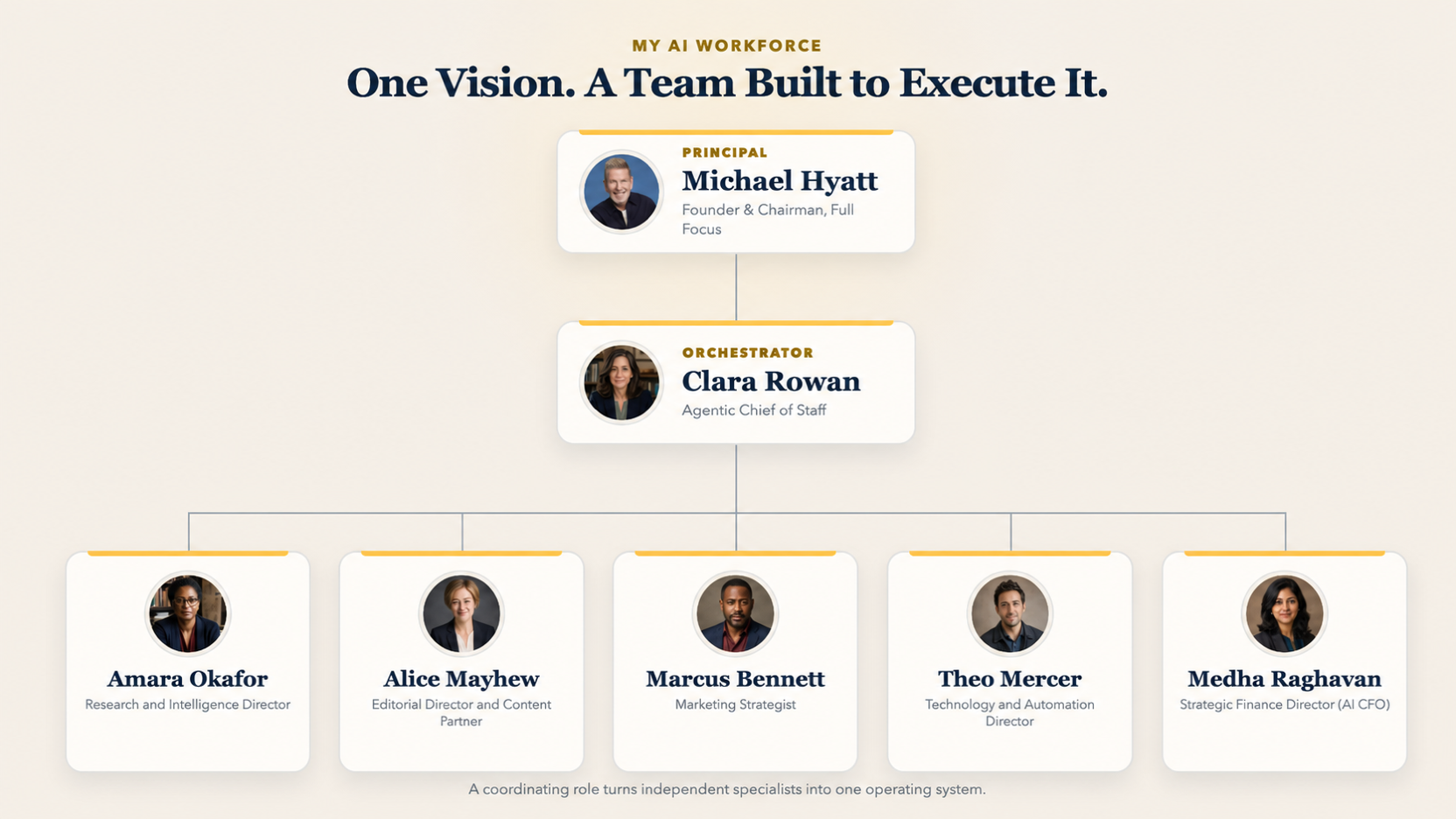
This is where the organization started to feel real. I gave each agent:
- a name,
- a title,
- an avatar,
- and a professional history.
Those details turned job descriptions into distinct coworkers, each with different strengths. Now I could give the assignment to Clara. She would clarify the outcome, delegate it to the right specialist, monitor the work, and bring the finished result back to me.
AI’s value comes from redesigning work around the capabilities those tools provide. In a 2025 survey, McKinsey tested twenty-five organizational practices and found that redesigning workflows had the strongest relationship with reported bottom-line impact from generative AI.3
For every role on your chart, write one sentence that begins, “This role exists to…” If the sentence is vague, the role is vague. Keep refining until the contribution is unmistakable.
Decision #3: Define How Work and Authority Will Flow
An org chart does more than name roles. It shows how work moves.
Who sets the priority? Who prepares the recommendation? Who reviews the result? Who has the authority to approve the final action? Leave those questions unanswered, and you’re still managing every handoff yourself.
My chief of staff coordinates priorities and routes assignments to the right specialist. The specialists contribute within their domains. I keep the decisions that require my judgment, values, personal knowledge, or approval.
This matters even more with AI in the mix. NIST’s AI Risk Management Framework calls for documented roles, clear lines of communication, executive accountability, and a defined division of responsibility between humans and AI systems.4 Whatever the size of your company, you need clear ownership.
For each reporting line on your chart, answer four questions:
- What does this role receive?
- What does it produce?
- Who reviews the work?
- What requires human approval?
These answers turn a picture into an operating model. They also expose gaps. If ownership overlaps or a critical handoff has no owner, fix the chart before the confusion reaches your calendar.
Decision #4: Staff the Chart in Phases
Your future-state chart will probably include more roles than you can deploy today. Good. The chart shows where you’re going. Your staffing plan shows what comes next.
Choose your first AI roles by asking where they create capacity. Which bottleneck eats the most of your attention? Which recurring responsibility has a clear input and output? Which role could create capacity without receiving authority it shouldn’t have yet?
Then add roles in phases as your workflows mature. Microsoft’s 2025 Work Trend Index describes a similar progression: AI starts as an assistant, develops into agents that work as digital colleagues under human direction, and can eventually run larger workflows while humans set direction and check the results. The progression isn’t strictly linear, and different functions can sit at different stages at the same time.5
That’s the practical way to staff a chart. You might have a mature research agent, an editorial agent that still needs close review, and a finance role you’ve only begun to define. The chart can hold all three without pretending they’re equally developed.
Build the Chart Before the Team
The four decisions are straightforward:
- Start with the outcomes you want.
- Design roles around those outcomes.
- Define how work and authority will flow.
- Staff the chart in phases.
An AI org chart makes your leadership more intentional. Instead of collecting disconnected agents, you build a coherent workforce around the business you’re trying to create.
Picture opening your laptop on Monday morning and knowing exactly who researches the opportunity, who shapes the message, who examines the numbers, and which decisions still belong to you. That’s the promise of designing the organization before you finish staffing it.
What would become possible if every important outcome in your business had a clear owner?
Comments
If you have a question about designing your AI workforce—or an org-chart insight you think I should consider, click here to send me an email. I read every one. Seriously. Your experiences help me write better content, and sometimes the best insights come from readers like you.
Transforming AI from noise to know-how,

P.S. Consider the AI Business Lab Mastermind: Running a $3M+ business? You’re past the startup chaos but not quite at autopilot. That’s exactly where AI changes everything. The AI Business Lab Mastermind isn’t another networking group—it’s a brain trust of leaders who are already implementing, not just ideating. We’re talking real numbers, real strategies, real results. If you’re tired of being the smartest person in the room, this is your new room. 👉🏼Learn more and apply here.
REFERENCE
- “Habit 2: Begin With the End in Mind”, FranklinCovey, accessed August 17, 2026. ↩︎
- EMyth Team, “The Importance of Your Organization Chart”, EMyth, accessed August 17, 2026. ↩︎
- Alex Singla, Alexander Sukharevsky, Lareina Yee, Michael Chui, and Bryce Hall, “The State of AI: How Organizations Are Rewiring to Capture Value”, McKinsey & Company, March 12, 2025. ↩︎
- “AI RMF Core”, NIST AI Resource Center, accessed August 17, 2026. ↩︎
- “2025: The Year the Frontier Firm Is Born”, Microsoft WorkLab, April 23, 2025. ↩︎