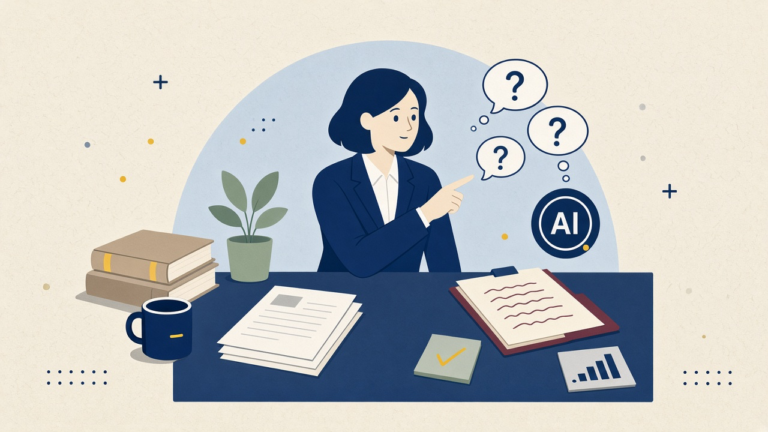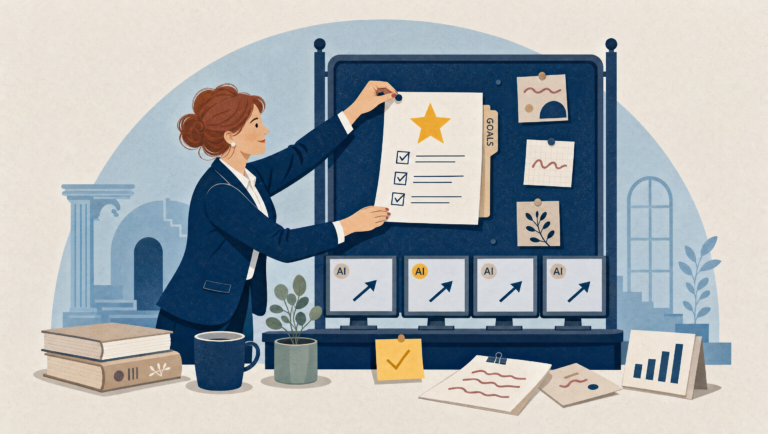

WEEKLY NEWSLETTER
The Inconvenient Question Gail Asked Me About AI

© CURRENT YEAR, AI Business Lab. All rights reserved.
AI is saving you time. So why are you working more than ever?
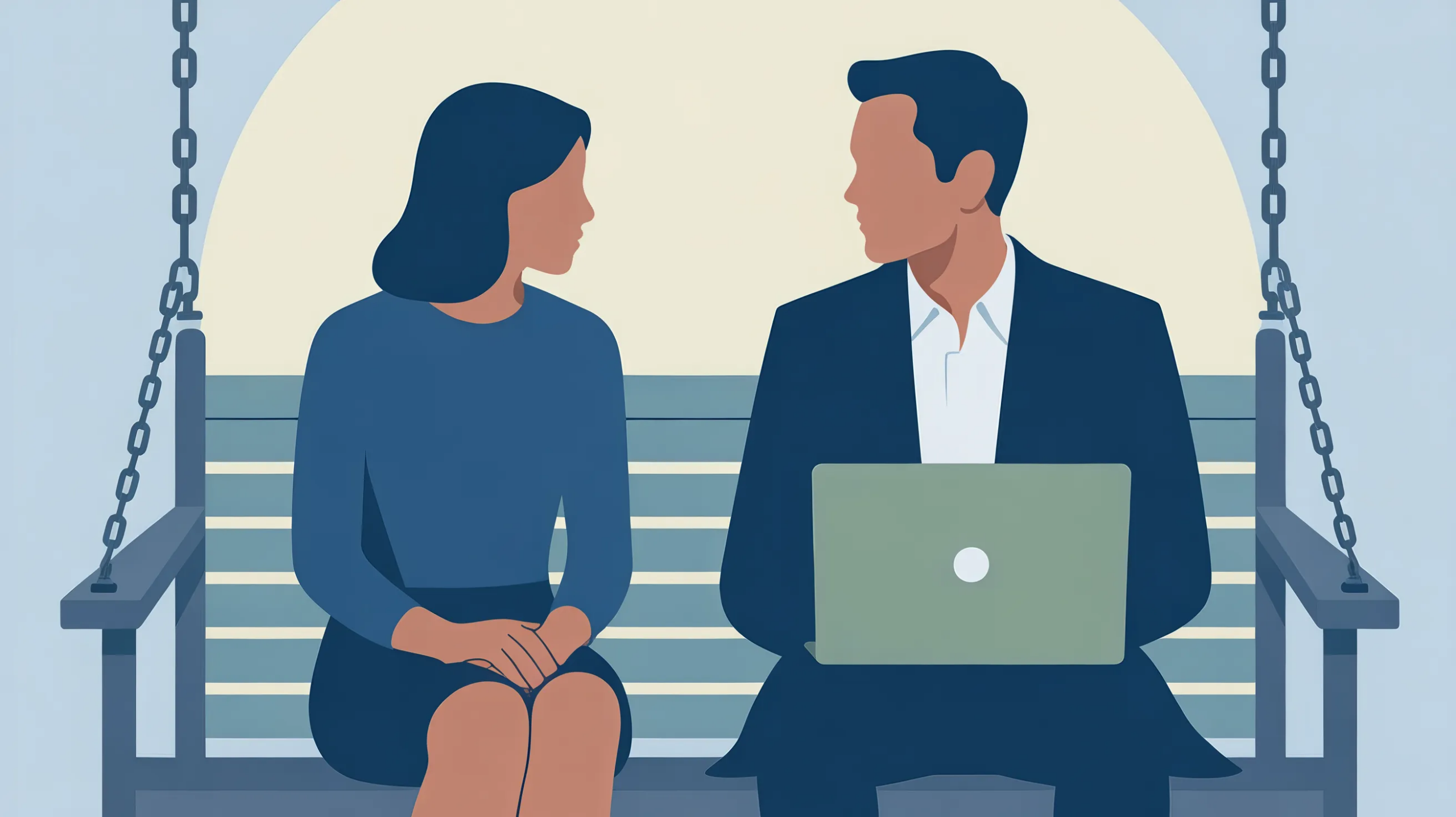
My wife Gail and I were sitting on the porch one evening—one of those quiet moments that used to come easier than they do now. She looked over at me and said, “If AI is supposed to be saving you time, why are you working more than ever?”
I opened my mouth to answer. And closed it again.
The honest truth was: I didn’t know.
I’d been telling anyone who would listen that AI had genuinely given me back hours. That was true. The newsletter that used to take me eight hours now takes ninety minutes. I wasn’t rounding the math. Six and a half hours, returned to me every single week.
But Gail sees the whole picture. She sees the laptop open after dinner. She sees the “just one more thing” before I come to bed. She sees what I’d been slow to admit to myself: that the hours AI gave back didn’t go anywhere good.
They just got filled.
That question stayed with me for days. It’s the kind of question that isn’t really a question. It’s a mirror. And I didn’t love what I saw in it.
This article is my attempt to answer her honestly. If you’ve been using AI for any length of time, I suspect you already know the answer too. You just haven’t said it out loud yet.
A few weeks ago I showed you how to reclaim two and a half hours a week by building one Claude skill. This is the honest sequel to that article. The time savings were real. The problem is what happened next.
AI does save time on individual tasks. That part isn’t hype. The AI productivity paradox isn’t that the tools don’t work. It’s that even when they work perfectly, the saved time has a way of disappearing. Three specific traps are responsible. If Gail’s question hit close to home, you’re probably running at least one of them.
Trap #1: The Refill Trap
The most predictable trap in the AI productivity paradox is the hardest to see from inside it.
You save an hour. Your brain, already conditioned to treat available time as capacity to be spent, immediately fills it. You draft three emails where you would have sent one. You start a project you wouldn’t have considered before AI. You add a third launch to a calendar that already had two.
I ran this play myself. The six and a half hours the newsletter gave me back? My first instinct was to fill them. More content. More offers. More of everything AI just made possible. It took me longer than I’d like to admit to recognize what was happening.
The saved time wasn’t being wasted. I was giving it back on purpose. Just not consciously.
Research from Harvard Business Review confirms this isn’t a discipline problem. AI tool adoption is correlated with increased work intensity across knowledge workers, not decreased.1 When the tool saves you time, the work expands to claim it. The trap doesn’t care how productive you are. It catches everyone.
Trap #2: The Ambition Trap
The second trap is subtler, and honestly, more dangerous, because it doesn’t feel like a trap. It feels like momentum.
When AI is working well, it collapses the distance between an idea and making it real. Projects that lived on a someday list (the kind you kept because they were good ideas, not because you had any realistic plan to pursue them) suddenly become I could actually do that. So you do. And then another. And then three more.
This is the AI productivity paradox at full speed. AI gives you back hours, and those recovered hours immediately fund ambitions you couldn’t afford a year ago. The result isn’t a lighter calendar. It’s a bigger one, running faster.
Economists call this the Jevons Paradox—the phenomenon in which efficiency improvements lead to more consumption of a resource, not less, because the lower cost makes use more attractive.2 The paradox isn’t new. It is, however, newly personal for anyone with a subscription and a project list.
Every yes that AI makes possible is still a yes. The trap is forgetting that.
Trap #3: The DIY Trap
I confessed to the third trap publicly in front of my AI Business Lab mastermind in April, and the room recognized itself immediately.
When AI can produce in two hours what used to take a week, the economics of delegation quietly change. Why hand a project to a specialist and wait two weeks when you and AI can get most of the way there by Thursday? So the work that used to leave your plate stays on it: the design brief, the research summary, the first build, the polished draft. You become both the leader and the contractor, running on AI-powered horsepower.
I described it as the boundary problem. AI compresses timelines so dramatically that I now find myself deep inside projects for hours, when the old-world answer would have been to hand it off and wait. My daughter Marissa, who runs marketing at Full Focus, pushed back gently from the audience. “You’re not alone,” she said. “That’s me too.”
It wasn’t a comfort. It was confirmation. Research on how generative AI shifts knowledge workers’ time bears this out. AI doesn’t just speed up individual tasks; it draws workers into a broader range of tasks than they handled before.3
The DIY trap doesn’t care about your title or your team size. Give it an AI subscription and a strong work ethic, and it will find you.
The Way Out
All three traps share one root. We treat the time AI gives back as free capacity—something available to be spent on whatever comes next. It isn’t. It’s recovered life.
The shift is simple to describe and harder than it looks to execute. Before AI refills the saved hour, decide what it’s for. Not a vague category. A specific commitment. The work only you can do. Time with the people only you can love. The long walk that finally lets you think clearly.
Here’s what I protect those six and a half hours for now. When one of my grandkids drops by in the afternoon, I stop what I’m doing and spend thirty minutes with him. Gail and I have evenings back. We sit on the screened-in porch at the lake and have the slow, unhurried conversations that used to get squeezed out of the week entirely. That is what AI work-life balance actually looks like: not a productivity benchmark, but a standing decision not to refill.
The discipline isn’t a better time-management system. It’s a prior commitment: this time is not for more work. Decide before the refill happens. Because if you don’t decide, something will decide for you. The next email, the next project, the next thing AI just made possible.
Three traps. One root. One way out.
AI saves time. That part is real, and it’s worth celebrating. The question is what happens in the next five seconds after the savings land. Left unguarded, recovered hours become refilled hours. The AI productivity paradox wins by default.
You don’t need a better AI tool to break it. You need a prior decision: the time AI gives back is recovered life, not free capacity. Protect it before it gets claimed. Hold it for what matters most. And when you walk away from your desk, walk away from something worth protecting.
Imagine what the next year looks like if you make that one decision. And hold to it.
The next hour AI saves you—have you already decided what it’s for?
Comments
If you have a question about using AI to save you time without working more, click here to send me an email. I read every one. Seriously. Your experiences help me write better content, and sometimes the best insights come from readers like you.
Transforming AI from noise to know-how,

P.S. Consider the AI Business Lab Mastermind: Running a $3M+ business? You’re past the startup chaos but not quite at autopilot. That’s exactly where AI changes everything. The AI Business Lab Mastermind isn’t another networking group—it’s a brain trust of leaders who are already implementing, not just ideating. We’re talking real numbers, real strategies, real results. If you’re tired of being the smartest person in the room, this is your new room. 👉🏼Learn more and apply here.
REFERENCE
- Aruna Ranganathan and Xingqi Maggie Ye, “AI Doesn’t Reduce Work—It Intensifies It”, Harvard Business Review, February 9, 2026. ↩︎
- Torsten Slok, “A 160-Year-Old Paradox Explains Why AI Will Create More Lawyers and Accountants—Not Fewer”, Fortune, April 28, 2026. ↩︎
- “Generative AI Changes How Employees Spend Their Time”, MIT Sloan Management Review, March 10, 2026. ↩︎