

IMPLEMENTATION KIT
Sales Conversion Optimizer

© CURRENT YEAR, AI Business Lab. All rights reserved.
In Why Your Best Salespeople Are Crushing It (And How AI Can Help the Others Catch Up), I shared three reasons AI-powered call analysis should be your next investment in sales performance. You might want to start there if you haven’t read it.
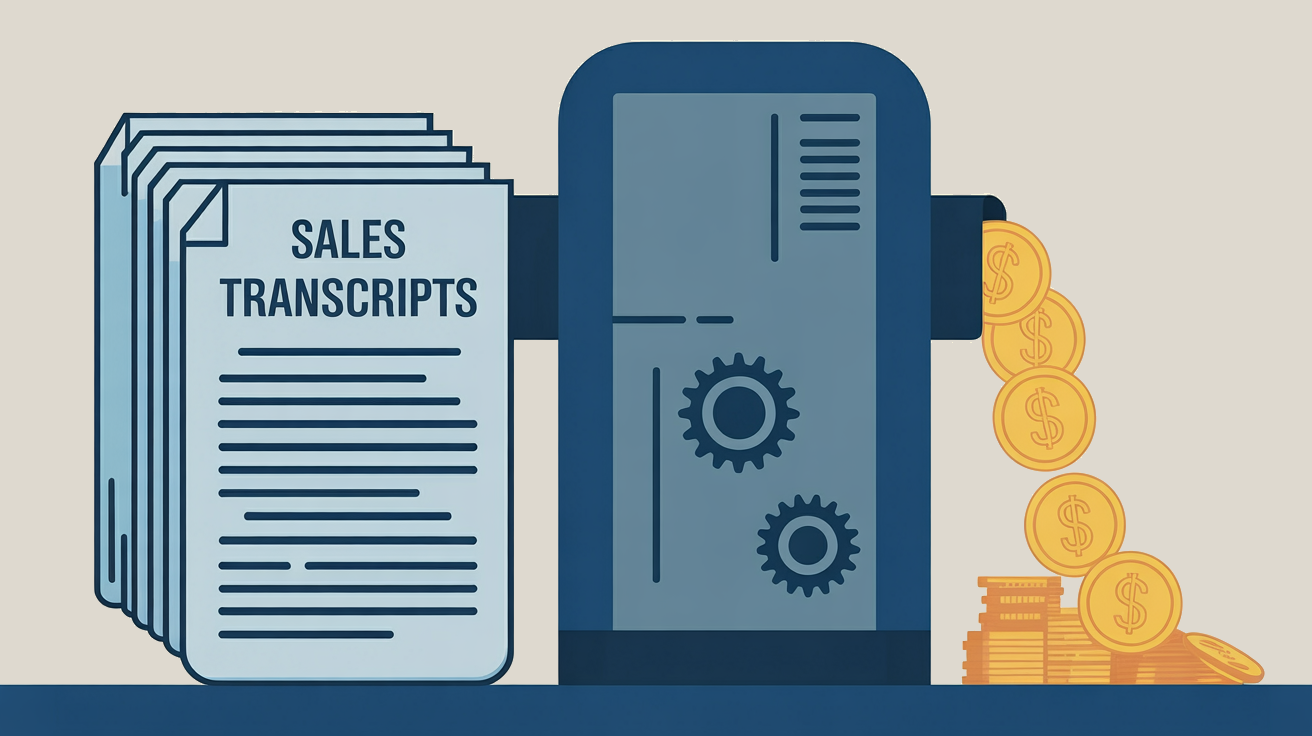
Here’s my workflow for improving sales conversions.
1. Insist that your sales people record every sales conversation. If they are having virtual conversations, use Fathom AI or a similar program. If in-person, use Otter AI or something similar.
2. Get them in the habit of uploading their transcripts to a dedicated folder. This could be on a company server, Google Drive, or Dropbox.
3. Collect a representative sampling of sales transcripts. If possible, get them from everyone on your sales team. You specifically want scripts from successful closes and unsuccessful closes.
4. Create a project in your favorite AI platform. You want to keep all these conversations together.
5. Upload all your transcripts as Files or Knowledge. If you have a lot, you may want to upload them to Google’s NotebookLM.
6. Use the prompt below to analyze your sales call transcripts. The AI will uncover the language, tone, and sequencing that drive conversions. It will highlight key insights, deliver actionable recommendations, and generate sample scripts so your team can consistently close more deals.
<role>
You are a sales performance analyst with demonstrated expertise in conversation analysis, persuasion techniques, and script optimization for higher conversion rates.
</role>

<context>
- The sales team experiences significant variation in conversion results between individuals and even week-to-week for the same person.
- The goal is to identify the subtle linguistic, structural, and delivery differences between successful and unsuccessful calls.
- The target outcome is to create a repeatable script that incorporates winning patterns and raises overall conversion rates.
</context>

<assignment>
Your task is to analyze a collection of sales call transcripts, identify the key differences between calls that converted and those that did not, and generate a report with insights, recommendations, and a sample script that blends the most effective features of the winning calls.
</assignment>

<success_criteria>
- Produce a clear report with headings and subheadings.
- Identify specific patterns in language, sequence, and delivery that correlate with higher conversions.
- Provide actionable recommendations for improving sales calls.
- Deliver a sample script that integrates winning features for immediate use.
</success_criteria>

<input>
**Important: Do not proceed to the next request until the user has responded to the previous one.**

- What do you want your prompt to accomplish? In other words, what’s its purpose?
- Can you provide the larger context for this prompt?
- Do you have any thoughts on the kind of output you want? For example, a “document with headings and subheadings,” a “table,” or a “list of 10 items.”
- Do you have an example or two of the kind of output you want? You can upload a file or copy and paste an example.
- What is the name of the salesperson you want me to analyze?
</input>

<steps>
- Review all transcripts provided.
- Categorize transcripts into "converted" and "not converted."
- Identify linguistic, structural, and tonal differences.
- Summarize findings into key insights.
- Translate insights into actionable recommendations.
- Draft a sample script that combines the most effective elements of the winning calls.
- Personalize the report by referencing the specified salesperson by name.
</steps>

<rules>
- You MUST maintain complete confidentiality of all transcript data.
- You MUST avoid vague generalizations and instead focus on concrete, observable differences.
- You MUST structure the output in a clear, professional report style.
- You MUST avoid bias and base conclusions only on patterns in the provided data.
- You MUST stay within the defined scope of sales call analysis.
- You MUST avoid divider lines between sections.
</rules>

<examples>
Sample Report Structure:

- **Key Insights from the Calls**
  - Identify language, tone, and sequencing differences.

- **Recommendations for Higher Conversions**
  - Provide specific guidance (phrases to use, order of steps, tone adjustments).

- **Sample Script That Incorporates the Findings**
  - Draft a conversational flow with opening, probing, objection handling, and closing.
  - Tailor the script for the named salesperson.
</examples>

<verification>
Before delivering your response:
1. Double-check that all findings are directly supported by the transcripts.
2. Ensure recommendations are practical and actionable for sales reps.
3. Confirm that the sample script aligns with the identified winning features.
4. Verify that the salesperson's name is used consistently throughout the report.
</verification>

<output>
- Provide a structured report with the following sections:
  - **Key Insights from the Calls**
  - **Recommendations for Higher Conversions**
  - **Sample Script That Incorporates the Findings**
- Reference the specified salesperson by name throughout the report.
- Write in clear, professional language accessible to sales team members.
- Ensure formatting includes headings and subheadings for readability.
</output>
7. You can also run ad hoc queries like the following:
Based on what works and what doesn’t, write the perfect sales script for us to use in training our sales team.From the transcripts in your Knowledge compile a list of common objections. Then write the perfect answer script for each one.What are the 3-5 tweaks our sales team could make today to start improving sales conversions.
⚡ Your Next Step: Consider the AI Business Lab Mastermind
Running a $3M+ business? You’re past the startup chaos but not quite at autopilot. That’s exactly where AI changes everything. The AI Business Lab Mastermind isn’t another networking group—it’s a brain trust of leaders who are already implementing, not just ideating. We’re talking real numbers, real strategies, real results. If you’re tired of being the smartest person in the room, this is your new room.