

WEEKLY NEWSLETTER
I Trained ChatGPT for Months. Then I Left.

© CURRENT YEAR, AI Business Lab. All rights reserved.
You’re not stuck with ChatGPT. You just think you are.
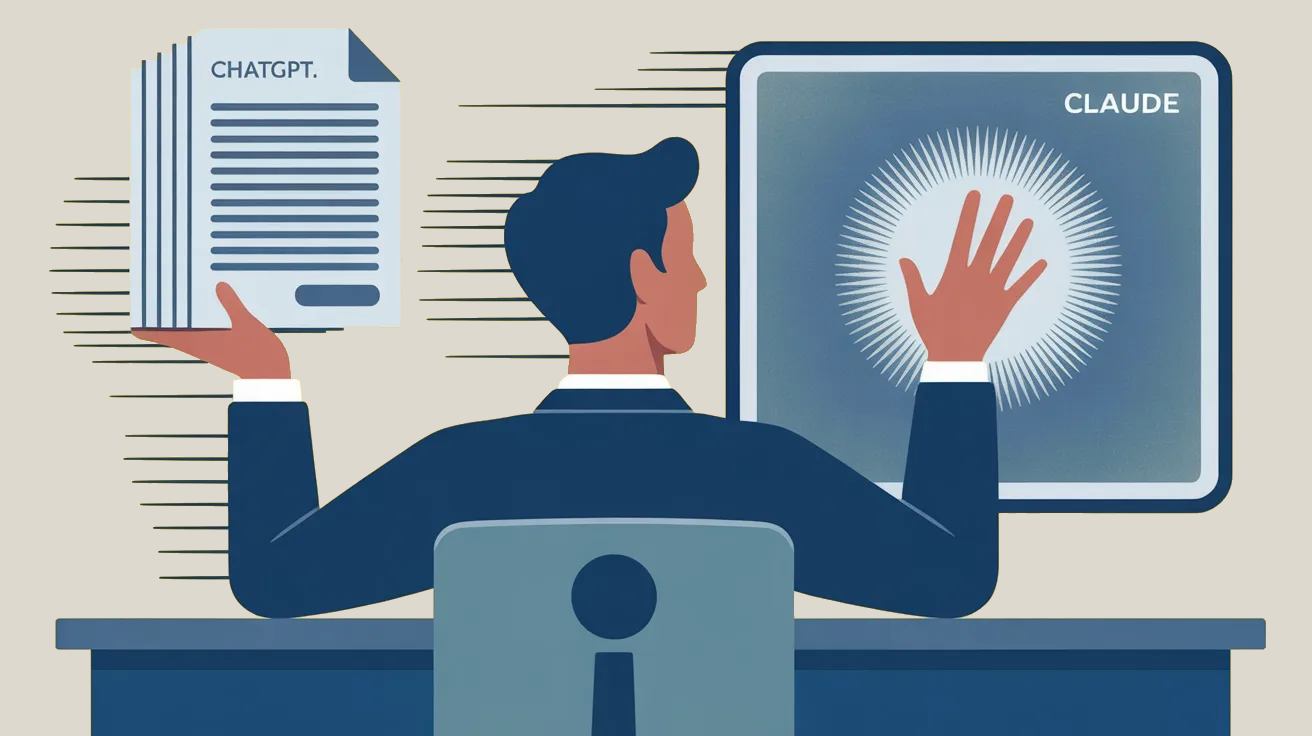
For months leading up to last August, I was doing 90% of my AI work in ChatGPT. I had spent hundreds of hours building my setup—dozens of custom GPTs, carefully tuned memory, conversation threads I referenced weekly. It felt like a finely calibrated machine.
Several friends kept urging me to try Claude. “The output is dramatically better,” they said. I nodded politely and changed the subject. I wasn’t about to walk away from all that work.
Then, on August 7th, OpenAI released ChatGPT 5.0.
I still remember opening it that morning, pasting in a prompt I’d used a hundred times before—and staring at the result. Something was wrong. The tone was off. The structure had collapsed. I ran another prompt. Same thing. Then another. It was like my trusted assistant had been replaced overnight by someone who’d never met me.
That was the push I needed. I finally gave Claude a serious look—and found it superior in almost every way. The writing was more natural. The reasoning was sharper. It actually pushed back when my thinking was sloppy, instead of just telling me what I wanted to hear.
Since then, Anthropic has improved Claude at a dizzying pace. Cowork and Claude Code have made it even more capable. Today, I’m doing 90% of my work on Claude and only occasionally going back to ChatGPT.
I hate to sound like a fanboy. But I’ve grown used to the experience of my jaw dropping almost daily at the kind of output I’m getting.
If my experience sounds familiar, you’re not alone. Over the past few months, business owners have been leaving ChatGPT for Claude in record numbers. Daily signups have quadrupled. Paid subscriptions have more than doubled. Claude recently hit number one in the App Store for the first time—surpassing ChatGPT.1
Some are switching because they’ve found Claude’s output genuinely superior. Others are motivated by Anthropic’s willingness to draw ethical lines around how their technology gets used—even when it cost them a lucrative government contract. Whatever the reason, the migration is real and it’s accelerating.
But here’s the thing. Many business owners who want to make the switch are still holding back. They’ve spent months—sometimes years—training ChatGPT. They’ve built custom GPTs, accumulated memories, and developed conversation histories they rely on. Walking away from all that feels like throwing away an investment.
You’ve probably told yourself that switching AI tools would mean starting over from scratch. But that story is outdated. Here are three realities that should change your mind about making the move from ChatGPT to Claude.
Reality #1: Claude Has Pulled Ahead Where It Matters Most for Your Business
Let me be honest with you. This isn’t about brand loyalty or picking teams. It’s about output quality—the thing that actually affects your bottom line.
Claude consistently produces writing that sounds more like a human and less like a machine. If you’ve ever wrestled with ChatGPT’s tendency to give you five paragraphs of filler when you asked a simple question, you’ll notice the difference immediately. Claude gives you a direct answer. No padding. No fluff. Many users report that they actually read Claude’s responses instead of skimming them—because there’s nothing to skip.2
But it goes deeper than writing style. Claude reasons through complexity in a way that feels genuinely collaborative. Ask it to analyze a financial report, review a contract, or develop a marketing strategy, and it doesn’t just execute your prompt. It asks clarifying questions. It challenges weak assumptions. It suggests approaches you hadn’t considered. One independent comparison described it as the difference between “a tool that completes tasks” and “a partner that thinks strategically.”3
Then there’s context. Claude’s context window—the amount of information it can hold in a single conversation—is significantly larger than ChatGPT’s. That means you can upload entire documents, reference long conversation histories, and provide rich background without hitting a wall. For business owners who deal with complex projects, this is a practical game-changer.
And Anthropic’s pace of improvement has been relentless. Features like Cowork (a desktop agent that works with your files) and Claude Code (a terminal-based development tool) have expanded what’s possible. Claude isn’t just catching up to ChatGPT’s ecosystem. In several critical areas, it’s already ahead.
Reality #2: Anthropic Built a Bridge So You Don’t Have to Start Over
Here’s the reality that removes the biggest objection: you can bring almost everything with you. Anthropic specifically built tools to make migration painless.
Your memory transfers in about 60 seconds. Anthropic created a dedicated import tool at claude.com/import-memory. The process is almost comically simple. You copy a pre-written prompt, paste it into ChatGPT, and ChatGPT generates a complete export of everything it knows about you. Then you paste that into Claude’s import tool. Done. Claude learns your preferences, your role, your projects, and your working style—all in one step.4
Your Custom GPTs become Claude Projects. If you’ve built specialized assistants in ChatGPT, Claude’s Projects feature is the equivalent—and it’s actually more powerful. Copy your Custom GPT’s instructions, upload the same knowledge files, and Claude maintains that context across every conversation in the project. The key advantage: Claude loads your entire knowledge base into context simultaneously, instead of pulling isolated snippets. It can see connections across all your documents at once.5
Your most valuable conversations can come too. You can’t recreate individual chat threads. But you can ask ChatGPT to summarize your most important conversations, then upload those summaries into Claude Projects as reference material. For power users, ChatGPT also offers a full data export through Settings > Data Controls > Export Data.
Here’s what I’d recommend as a simple strategy: Start by importing your memory (60 seconds). Then transfer your top two or three Custom GPTs into Claude Projects (10–15 minutes each). Finally, summarize and migrate your five most valuable conversation threads. The entire process takes less than an hour—and your Claude account will feel personalized from the very first conversation.
Reality #3: Staying Put Is Now the Riskier Choice
Most business owners assume that switching is the risky move. But consider the alternative.
AI is moving at an extraordinary pace. The tools you use today will shape your competitive advantage for years to come. And right now, Claude is setting the pace for what AI assistants can do—particularly for business applications like writing, analysis, strategy, and coding.
Staying with a tool because you’ve “already invested the time” is a classic example of the sunk cost fallacy. The time you spent training ChatGPT is spent regardless of what you do next. The real question is: which tool will give you the best results going forward?
Here’s what I’ve learned from making the switch myself: the “investment” you think you’re protecting is far more portable than you realize. Your preferences, your context, your working style—all of that travels with you. What doesn’t travel is the months of better output you’re leaving on the table by sticking with a tool that’s no longer your best option.
And you don’t have to make an all-or-nothing decision. Keep your ChatGPT account active. Use it for the things it still does well, like fast factual research. But make Claude your primary workspace for the work that matters most—writing, thinking, analyzing, and building.
The business owners who will win in the age of AI aren’t the ones who picked a tool and stayed loyal. They’re the ones who stay flexible, follow the best output, and treat their AI investment as portable—not permanent.
Imagine what your workweek looks like when your AI assistant actually thinks alongside you. When it challenges your assumptions instead of flattering them. When the output is so good that you stop editing and start shipping.
That’s not a fantasy. That’s what Tuesday morning looks like when you make the switch.
What’s holding you back from giving Claude a serious try?
Comments
If you have a question about migrating from ChatGPT to Claude, click here to send me an email. I read every one. Seriously. Your experiences help me write better content, and sometimes the best insights come from readers like you.
Transforming AI from noise to know-how,

P.S. Consider the AI Business Lab Mastermind: Running a $3M+ business? You’re past the startup chaos but not quite at autopilot. That’s exactly where AI changes everything. The AI Business Lab Mastermind isn’t another networking group—it’s a brain trust of leaders who are already implementing, not just ideating. We’re talking real numbers, real strategies, real results. If you’re tired of being the smartest person in the room, this is your new room. 👉🏼Learn more and apply here.
REFERENCE
- Lauren Forristal, ”Users Are Ditching ChatGPT for Claude—Here’s How to Make the Switch”, TechCrunch, March 2, 2026. ↩︎
- Discussion thread, ”Switch to Claude Without Starting Over”, Hacker News, March 14, 2026. ↩︎
- Ryan Kane, ”Claude vs. ChatGPT: What’s the Difference?”, Zapier, March 2026. ↩︎
- Anthropic, ”Switch to Claude Without Starting Over”, Claude.com, 2026. ↩︎
- Anthropic, ”How Can I Create and Manage Projects?”, Claude Help Center, 2026. ↩︎