

WEEKLY NEWSLETTER
Claude Skills: The Feature That Makes Claude 10x Smarter

© CURRENT YEAR, AI Business Lab. All rights reserved.
If you’re retyping the same instructions into Claude every morning, you’re onboarding the same employee every single day.
When I first heard about Claude Skills, I froze.
I was sitting in a mastermind session, watching a colleague demo something that looked incredible—Claude formatting a perfect client proposal in seconds, following his exact brand guidelines, without a single prompt. “It’s a Skill,” he said, like that explained everything.
It didn’t. I nodded along, pretended I got it, and quietly moved on.
I should have just dove in and figured it out for myself—which is usually the best way to learn AI. But I didn’t. I procrastinated for weeks. Meanwhile, I kept retyping the same instructions into Claude every single session, wasting twenty or thirty minutes a day rebuilding context that should have been automatic.
And honestly? Claude didn’t make it easy back then. You had to write the Skill by hand. Save it as a zip file following a very specific protocol. Upload it and hope nothing broke. Half the time it did, and you had no idea why. So I kept telling myself I’d get to it “next week.”
Then Anthropic changed everything. They redesigned how Skills work so you can turn any prompt into a Skill just by asking Claude to build it. No zip files. No manual formatting. One click to install.
That single change turned Skills from something I avoided into something I use every single day. And once I finally understood what they were—and what they could do—I realized I’d been leaving hours on the table every week.
If you’ve ever wondered whether Claude has something like ChatGPT’s custom GPTs, the answer is yes—and it’s actually more powerful. You can make Claude work the way you work by considering the answers to these four questions.
Question #1: What Exactly Is a Claude Skill?
Here’s the simplest way I can explain it.
Imagine you just hired a brilliant new employee. They’re smart, capable, and eager to help. But they don’t know your business yet. They don’t know your processes, your preferences, or how you like things done. So you onboard them. You walk them through your SOPs. You explain your brand voice, your reporting format, your client communication style.
Now imagine you could skip all of that—and instead insert a chip directly into their brain that instantly downloaded the entire SOP. From that moment forward, they just know how to do the task. No training period. No repeated explanations. No mistakes from miscommunication.
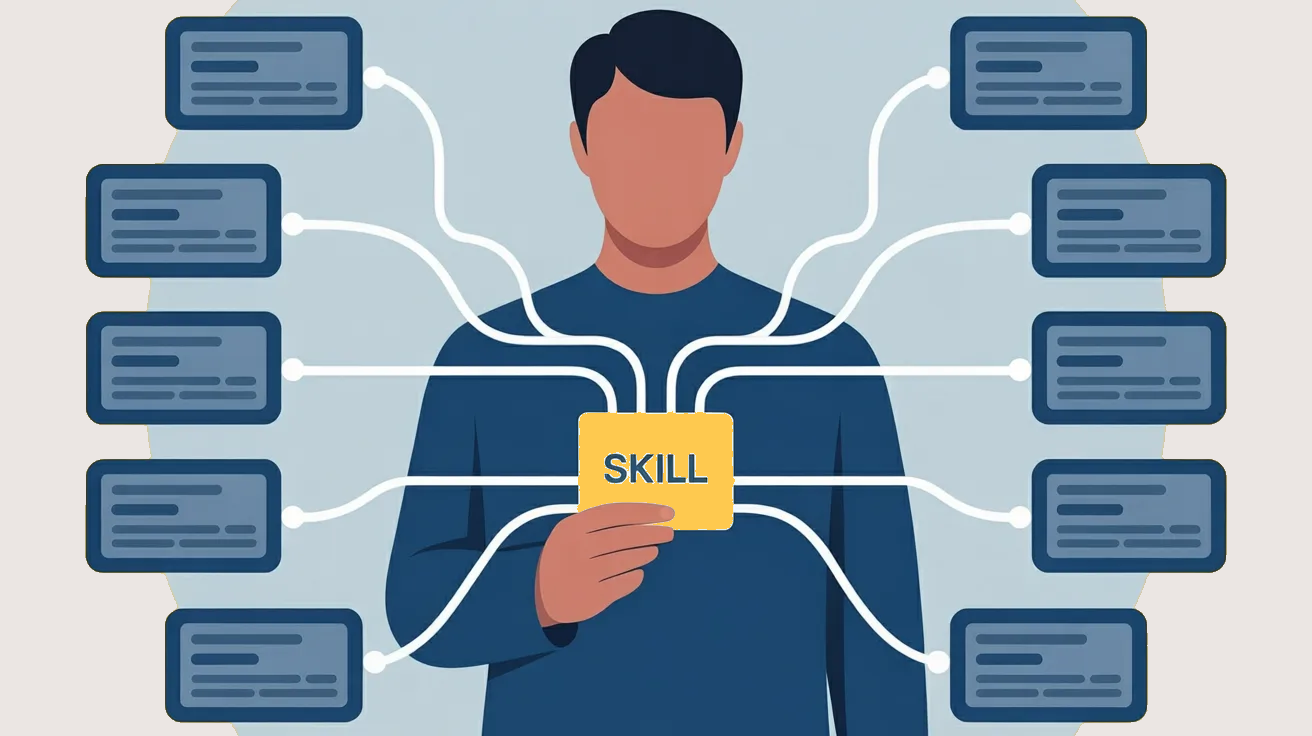
That’s what a Claude Skill is. It’s a set of instructions—packaged into a simple file—that teaches Claude exactly how to perform a specific task, every single time, without you re-explaining it.
Anthropic defines Skills as “folders of instructions, scripts, and resources that Claude loads dynamically to improve performance on specialized tasks.”1 But in plain English? A Skill is an SOP for your AI. You build it once, and Claude follows it automatically whenever the task comes up.
Here’s where it gets practical. Without a Skill, every conversation with Claude starts from scratch. You explain your formatting preferences. You remind it of your brand voice. You paste in the same context you pasted in yesterday. It’s like onboarding that same new employee every single morning.
With a Skill, you do that work once. After that, Claude recognizes the task, loads your Skill, and delivers exactly what you need—formatted correctly, in your voice, following your process.
Question #2: Why Are Skills So Powerful?
Three words: consistency, speed, and portability.
Consistency. When you create a Skill, Claude follows the same process every time. No drift. No forgotten steps. No “I forgot you wanted it that way.” Research from Harvard Business School found that companies with documented, repeatable processes grew revenue 30% faster than those without them.2 Skills bring that same discipline to your AI workflows.
Speed. A Skill eliminates the setup time that kills your momentum. Instead of spending the first five minutes of every conversation re-establishing context, you jump straight to the output. I’ve personally reclaimed twenty to thirty minutes every day since building my core Skills library. Over a week, that’s more than two hours of productive time recovered.
Portability. This is what makes Skills different from anything else in the AI landscape. Anthropic published the Agent Skills format as an open standard—and the rest of the industry followed. OpenAI adopted the same format for ChatGPT and its Codex CLI tool. Perplexity launched Custom Skills in March 2026. Google’s Gemini CLI, GitHub Copilot, Cursor, and more than a dozen other platforms now support the same SKILL.md specification.3
Let that sink in. A Skill you build for Claude today works across 16+ AI tools without modification. That’s not a feature. That’s an industry standard. And it means the time you invest in building Skills isn’t locked into one platform—it’s portable expertise you can carry anywhere.
Question #3: How Can I Create My First Skill?
This is where most people expect me to say “it’s complicated.” It’s not. Not anymore.
The old way required you to write a SKILL.md file by hand, package it into a zip file, and upload it through Claude’s settings. It was tedious, error-prone, and intimidating for anyone without a technical background.
The new way? Just ask Claude to do it for you.
Here’s the process in three steps:
Step 1: Identify a task you repeat. Think about something you ask Claude to do over and over. Maybe it’s drafting client emails in a specific tone. Formatting weekly reports. Analyzing financial data with a particular framework. If you find yourself typing the same instructions more than twice, that’s a Skill waiting to be built.
Step 2: Ask Claude to turn it into a Skill. Once you have a prompt that works well, simply say: “Turn this into a Skill I can reuse.” Claude will create the properly formatted SKILL.md file, complete with a name, description, and detailed instructions.
Step 3: Install it with one click. Claude now generates a ready-to-install Skill package. Click the button, and it’s live. From that point forward, Claude automatically recognizes when the Skill applies and uses it—no slash commands or special syntax required.4
That’s it. The whole process takes less than five minutes.
Here’s a real example. Last week, I noticed I was manually formatting every Google Doc that Claude created for me. Same title style. Same subheads. Same fonts. Same header and footer. Every single time, I was doing it by hand—and it was driving me crazy. So I asked Claude to create a Skill for it. Now every document comes out perfectly formatted, exactly the way I want it, without me touching a thing.
And here’s the part most people miss: Skills aren’t set in stone. If something isn’t quite right—maybe you want the footer to include a different tagline, or you’d prefer a different heading font—just tell Claude to revise the Skill. It updates the file, and every future output reflects the change. Your AI gets smarter every time you refine it.
Once you’ve built your first Skill, you’ll immediately want to build five more.
Question #4: Where Can I Find Prebuilt Skills?
You don’t have to start from scratch. Claude comes with several built-in Skills that are ready to use right out of the box, including professional document creation for Word, PowerPoint, Excel, and PDF files.5
Beyond the built-in options, the Skills ecosystem has exploded. The Agent Skills marketplace at SkillsMP now lists over 500,000 skills you can browse, filter, and install.6 Anthropic’s own GitHub repository has over 87,000 stars.7 And Anthropic’s Skills Directory features professionally built Skills from partners like Notion, Figma, and Atlassian that work seamlessly with their respective integrations.8
Here’s my recommendation for getting started: don’t try to build a library overnight. Pick one task—the one you repeat most often—and either find a prebuilt Skill that handles it or ask Claude to build one for you. Use it for a week. Feel the difference. Then build the next one.
Before you know it, you’ll have a personalized AI assistant that knows your business as well as your best employee does—without the onboarding period.
Skills are the single most powerful feature most Claude users haven’t set up yet. They’re the difference between using Claude as a generic chatbot and using it as a custom-built tool that knows how you work. And with the entire industry converging on the same open standard, every Skill you build today becomes more valuable tomorrow.
Imagine what your week would look like if Claude already knew your processes, your preferences, and your standards—before you typed a single word.
What’s the one task you repeat most often that you’d want to turn into a Skill?
Comments
If you have a question about using Claude skills, click here to send me an email. I read every one. Seriously. Your experiences help me write better content, and sometimes the best insights come from readers like you.
Transforming AI from noise to know-how,

P.S. Consider the AI Business Lab Mastermind: Running a $3M+ business? You’re past the startup chaos but not quite at autopilot. That’s exactly where AI changes everything. The AI Business Lab Mastermind isn’t another networking group—it’s a brain trust of leaders who are already implementing, not just ideating. We’re talking real numbers, real strategies, real results. If you’re tired of being the smartest person in the room, this is your new room. 👉🏼Learn more and apply here.
REFERENCE
- Anthropic, “What Are Skills?”, Claude Help Center, accessed March 22, 2026. ↩︎
- Teresa Amabile and Steven Kramer, “The Power of Small Wins,” Harvard Business Review, May 2011. ↩︎
- Anthropic, “Agent Skills Overview,” AgentSkills.io, accessed March 22, 2026. See also: Serenities AI, “AI Agent Skills Guide 2026,” March 2026. ↩︎
- Anthropic, “Use Skills in Claude,” Claude Help Center, accessed March 22, 2026. ↩︎
- Anthropic, “Use Skills in Claude,” Claude Help Center, accessed March 22, 2026. ↩︎
- SkillsMP, “Agent Skills Marketplace,” accessed March 22, 2026. ↩︎
- Towards Data Science, “How to Build a Production-Ready Claude Code Skill,” March 2026. ↩︎
- Anthropic, “What Are Skills?”, Claude Help Center, accessed March 22, 2026. ↩︎