
WEEKLY NEWSLETTER
Stop Settling for Generic AI Output

© CURRENT YEAR, AI Business Lab. All rights reserved.
You ask AI for help. It gives you bland, generic output. You try again. Same result. You give up, convinced AI is overhyped. Let's fix that.
The first time I tried ChatGPT, Reader, I stared at my screen, waiting for magic.
I’d heard the hype. Everyone was raving about how AI would revolutionize everything. So I typed in a prompt, hit enter, and watched as the cursor blinked.
What came back? Generic drivel that could’ve been written by anyone, about anything, for no one in particular.
It didn’t know me. Didn’t understand my company. Had zero sense of my writing style. I felt like I’d just hired an intern who’d never read a single thing I’d written—and expected them to draft my next book chapter.
I was underwhelmed. Frustrated. Ready to write it off as overhyped tech that wasn’t ready for prime time.
But then I remembered something I’d learned decades ago in business: garbage in, garbage out. You can’t delegate effectively to humans without clear direction—why would AI be any different?
So I got intentional. I stopped expecting it to read my mind and started training it. I fed it examples of my writing. I clarified my frameworks. I taught it my perspective. And I kept iterating.
The transformation was stunning.
Now? When I use AI as a writing collaborator, the output often exceeds what I could produce on my own. It amplifies my ideas, sharpens my frameworks, and accelerates my thinking—because I invested the time upfront to teach it how I work.
Turns out, AI isn’t magic. It’s a tool. And like any tool, it’s only as good as the person wielding it.
The good news? You can train your AI to deliver ten times better results—and it’s simpler than you think. Here are three essential AI training documents you need to create.
Document #1: Your Personal Profile
Most people jump straight into asking AI for help without giving it any context about who they are. That’s like expecting a consultant to give you brilliant advice on your first phone call—without ever asking about your background, goals, or constraints.
The research backs this up. McKinsey found that seventy-one percent of consumers expect companies to deliver personalized interactions, and seventy-six percent get frustrated when it doesn’t happen.1 The same principle applies to AI. When you provide personal context, the output becomes dramatically more relevant.
AI isn't failing you. You're just not giving it what it needs to succeed.
Your personal profile should cover the essentials: your role, your expertise, your communication preferences, and your goals. Think of it as creating a comprehensive bio that helps AI understand not just what you do, but how you think.
Include details like your personality type (Myers-Briggs, Enneagram, whatever framework you use), your professional background, and even your personal values. The more context you provide, the better AI can tailor its responses to match your perspective.
I’ve created a simple custom GPT that walks you through building this profile. It asks the right questions and compiles everything into a document you can upload to any AI conversation. I’ll explain how to get it in a minute.
Document #2: Your Company Context
If you’re using AI for business, it needs to understand your company—not just its products and services, but its culture, values, and unique positioning in the market.
Research on AI context windows shows that models perform significantly better when they have access to relevant business information within their “working memory.”[2] Studies from Anthropic (maker of Claude.ai) reveal that thoughtful context engineering—providing the right information at the right time—dramatically improves AI agent performance and reduces errors.[3]
Your company context document should include:
- Your mission, vision, and core values
- Your ideal customer avatar
- Your brand voice and messaging guidelines
- Your key differentiators
- Your product or service offerings
- Competitive landscape
You can train your AI to deliver ten times better results—and it's simpler than you think.
This isn’t just corporate fluff. It’s strategic intelligence that helps AI generate content that actually aligns with your brand. When AI knows your target customer is a stressed-out small business owner (not a Fortune 500 executive), it writes completely different recommendations.
Again, I’ve built a custom GPT for this too—it guides you through capturing all the essential company information in a structured format that AI can easily reference. More in a minute.
Document #3: Your Writing Style
Here’s where the magic really happens. Once AI understands you and your company, it needs to learn how you write.
Recent studies on AI personalization show that when done correctly, personalized AI can reduce customer acquisition costs by up to fifty percent and increase revenues by five to fifteen percent.[4] But the real breakthrough comes when AI can actually write in your voice—not just mimic formal business language, but capture your unique tone, rhythm, and style.
Stop treating AI like a search engine and start training it like a team member.
Your voice document should analyze:
- Your tone (formal, conversational, authoritative, empathetic)
- Your sentence structure (short and punchy vs. longer and complex)
- Your word choices and phrases you use frequently
- Your use of metaphors, analogies, and stories
- Your paragraph length and formatting preferences
The fastest way to create this? Upload three to five samples of your best writing to a custom GPT designed to analyze your voice. It’ll extract the patterns and create a set of voice instructions you can use in any AI conversation.
I’ve tested this extensively. When I use my voice instructions, AI writes content that my team can’t distinguish from what I’d write myself. That’s not about AI replacing me—it’s about AI amplifying my capacity to serve more people with the same quality of insight.
Here’s the bottom line: AI isn’t failing you. You’re just not giving it what it needs to succeed.
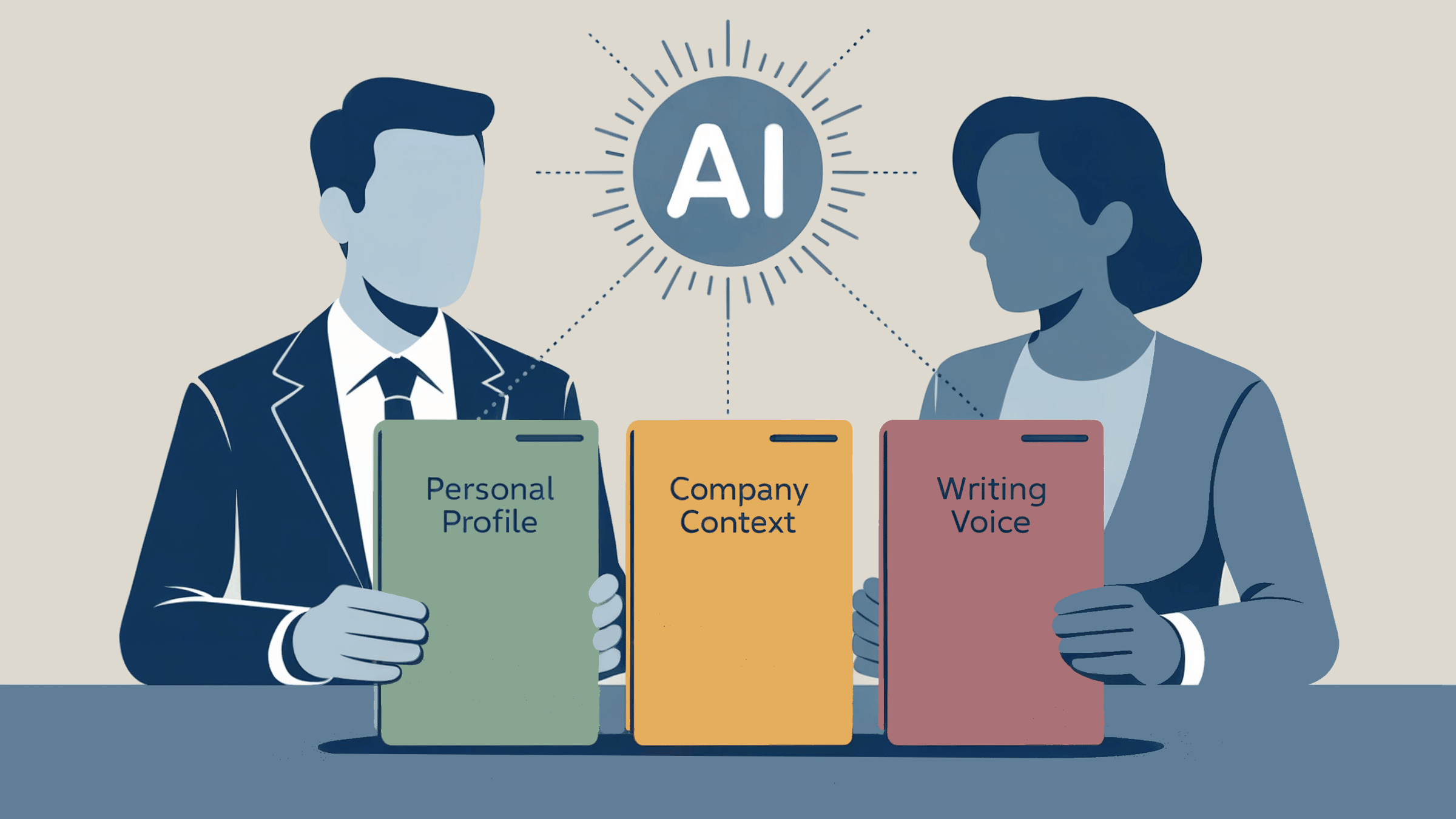
These three documents—your Personal Profile, your Company Context, and your Writing Voice—are the foundation for getting ten times better results from AI. They take a few hours to create, but they transform every interaction you have with AI from that point forward.
Imagine what becomes possible when AI actually understands you, knows your business, and writes like you write.
- Imagine the time you’ll reclaim.
- Imagine the quality of work you’ll produce.
- Imagine the impact you’ll make.
That’s not hypothetical. That’s what happens when you stop treating AI like a search engine and start training it like a team member.
What’s one way AI could transform your work if it actually understood you?
Comments
Got a question or story about making AI think more like you? Hit reply and let me know.
I read every email. Seriously. Your experiences help me write better content, and sometimes the best insights come from readers like you.
Transforming AI from noise to know-how,

Michael Hyatt
Founder & CEO
AI Business Lab
P.S. Consider the AI Business Lab Mastermind: Running a $3-10M business? You’re past the startup chaos but not quite at autopilot. That’s exactly where AI changes everything. The AI Business Lab Mastermind isn’t another networking group—it’s a brain trust of leaders who are already implementing, not just ideating. We’re talking real numbers, real strategies, real results. If you’re tired of being the smartest person in the room, this is your new room. 👉🏼 Learn more and apply here.
REFERENCE
- “The Value of Getting Personalization Right—or Wrong—Is Multiplying,” McKinsey, November 12, 2021, https://www.mckinsey.com/capabilities/growth-marketing-and-sales/our-insights/the-value-of-getting-personalization-right-or-wrong-is-multiplying.
- “Understanding Context Window for AI Performance & Use Cases,” Qodo, August 31, 2025, https://www.qodo.ai/blog/context-windows/.
- “Effective Context Engineering for AI Agents,” Anthropic, accessed October 7, 2025, https://www.anthropic.com/engineering/effective-context-engineering-for-ai-agents.
- “AI Personalization: What Actually Works in 2025 [Real Results],” Persana AI, accessed October 7, 2025, https://persana.ai/blogs/ai-personalization.