
WEEKLY NEWSLETTER
16 AI Writing Tells and How to Fix Them

© CURRENT YEAR, AI Business Lab. All rights reserved.
An em dash isn’t an AI tell. Forty of them is. Here are the 16 patterns that actually give machine-made writing away.
My son-in-law Joel has edited my writing for more than twenty-five years. He knows my voice better than I do.
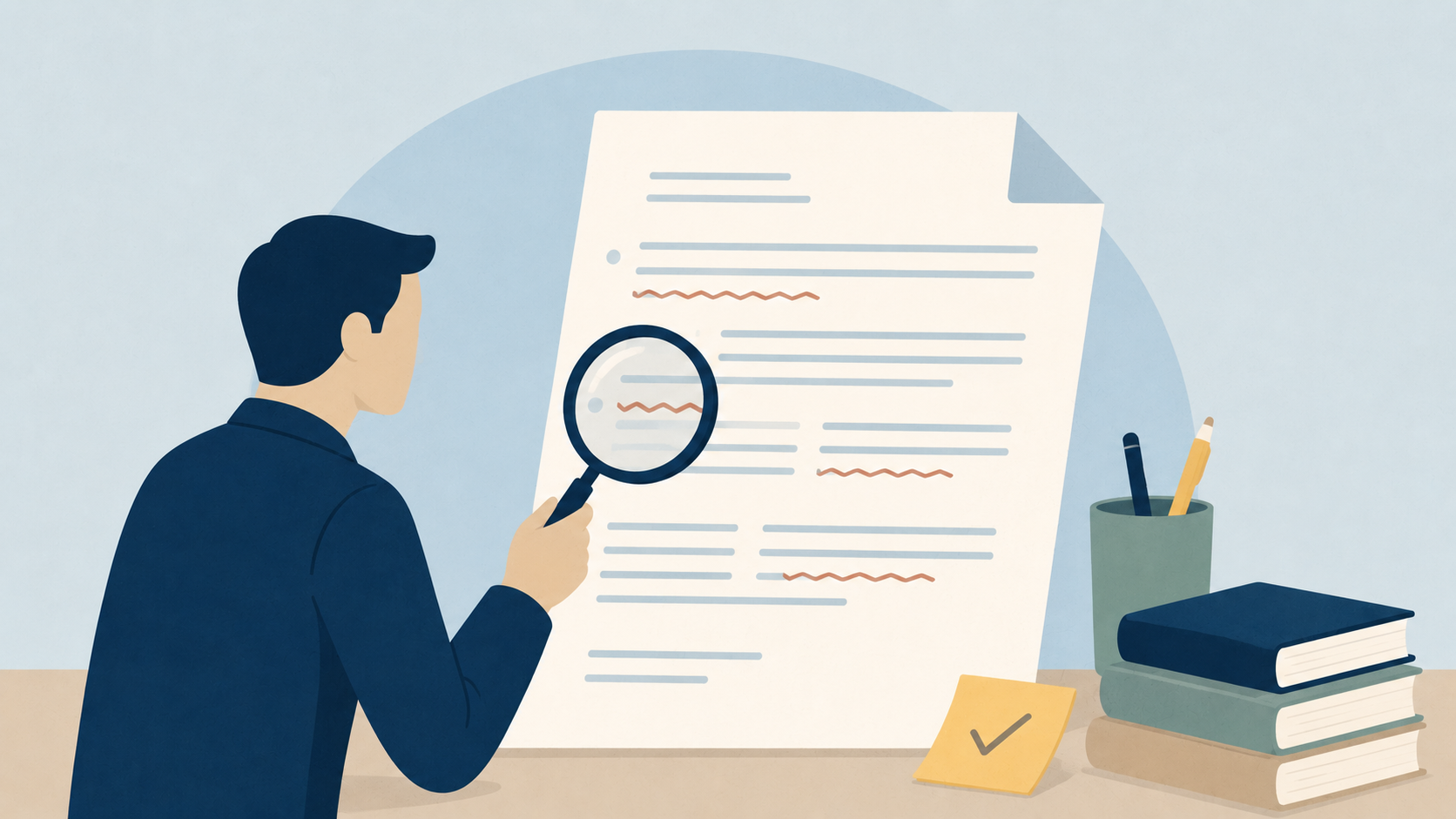
A few weeks ago he was marking up a webinar script I’d drafted with Claude. When the file came back, the margins were full of his comments. “This doesn’t sound like you.” “You’d never say this.” And the one that stung: “Dead giveaway you used AI.”
I cringed. Because he was right.
The worst part? I hadn’t been lazy about this. I’ve trained Claude on my voice for months—fed it my books, my articles, a whole style guide. And the tells still slipped through. I’d even read right past them. I’ve waded through so much AI slop this year that I’d gone blind to the very patterns I’d have caught in a heartbeat a year ago.
That’s the trap. The tells don’t announce themselves. They sit there looking like perfectly good writing, and your reader feels the wrongness before they can name it. Then they trust you a little less.
So I made myself a promise: never again. And I built a checklist to make sure of it.
Here’s that checklist. Sixteen patterns that quietly give a piece away as machine-made—call them tells, or the signs of AI writing, same thing. For each one I’ll show you what it is, why it reads as artificial, and what to do instead.
You can keep this list open when you edit, and run your own drafts against it before anything ships. (Better yet, I created a Claude skill for my Insider+ subscribers. If you’re not a member, I’ll point you to it in a few minutes.)
One thing to hold onto before we start. The tool is rarely the problem. Using it on autopilot is. An em dash is fine; forty em dashes is a tell. A crisp three-part list is fine; three of them in a row is a tell. So as you read, watch for the reflex, not the word.
How It Opens
The first tell usually shows up before the first real sentence. Watch the opening line.
1. The Universal-Stakes Opener
The grand wind-up that addresses everyone and lands on no one. “In today’s fast-paced world…” “Whether you’re a seasoned executive or just starting out…” The stage is set so wide that nothing specific can stand on it. Open small instead: one person, one moment, one problem. “Last Tuesday a client told me he hadn’t seen his kids awake in three days” beats any sweeping setup.
2. Throat-Clearing Openers
The conversational warm-up that promises candor instead of delivering a point. “Here’s the thing.” “Let me be honest with you.” “Can I be real for a second?” The reader waits through the windup to find out there was nothing to clear. Cut it and start with the point. If you want weight, use a short declarative line, not a runway.
3. The False-Exclusivity Teaser
The curiosity-gap opener that dangles hidden knowledge. “Here’s what nobody’s telling you.” “The secret the experts won’t share.” It overpromises every time, and the payoff never matches the velvet rope. State the insight plainly. If it’s good, it doesn’t need a bouncer.
4. The Let’s-Dive-In Cue
The chipper send-off that announces you’re about to begin instead of beginning. “Let’s dive in.” “Ready to get started?” “Buckle up.” It’s scaffolding with no information in it. (A real roadmap is different: “Here are three reasons this matters” is honest signposting, and it stays.) Cut the cue and let the first real sentence carry the reader in. If the setup did its job, they’re already there.
How It Moves
Past the opening, the tells live in rhythm and logic, in how your sentences carry an idea from one to the next.
5. The False Binary
“It’s not about working harder. It’s about working smarter.” The not-X-but-Y construction manufactures the feeling of insight without the work of having one. Used once, at a real turn, it’s a hinge. Used four times, it’s a robot. Hold it to once a piece, or let the contrast stay implicit and trust the reader to feel it.
6. The Compulsive Rule of Three
Everything arrives in balanced triads. Every noun gets two siblings; every list runs exactly three items, each the same length. “It saves time, reduces stress, and boosts focus.” Read three sentences built that way and your ear knows. Vary the count. One item. Or two. Or four. One crafted triad per piece is plenty.
7. Glue-Word Transitions
The connectors that announce a thought instead of just thinking it. “Moreover.” “Furthermore.” “It’s worth noting that.” Grammatically fine, rhetorically dead. Cut them and start with the point. The sentence almost always gets stronger the instant the glue is gone.
8. Metronome Rhythm
Every sentence the same length, ticking along at one tempo with no short jabs and no long runs. Even clean prose reads synthetic when the rhythm never breaks. Vary it on purpose. Short. Then a longer sentence that carries the weight of the idea and earns its length. Then a fragment. Human writing is uneven, so lean into the unevenness.
9. The String of One-Sentence Paragraphs
Every sentence on its own line, white space between each, the whole way down. A single-sentence paragraph is a real move, a punch or a beat. The tell is the relentlessness, when nothing is ever grouped and the page reads like a chat thread. Cluster the lines that belong together into real paragraphs, and save the solo line for the moment that earns the spotlight.
The Words It Reaches For
Some tells hide at the level of a single word: the synonym the model loves more than people do.
10. The Thesaurus Words
A small clutch of words the models reach for far more than we do. “Delve into.” “A rich tapestry of.” “Underscore.” “In the realm of.” “Seamless.” None is wrong; stacked together they read as a machine grasping for a fancier synonym. Trade down. “Delve into” becomes “dig into.” “Underscore” becomes “show.” Plain words carry more weight, not less.
11. The Collocation Trap
This one’s sneaky, because the word is yours—the pairing gives you away. “Navigate” is a fine verb. “Navigate the ever-changing landscape” is a phrase that came pre-assembled. Same with “unlock your full potential” and “leverage synergies.” Keep the verb, kill the cliché it came packaged with.
12. Copula Inflation
Plain “is” and “are” dressed up in a suit. “Delegation serves as a critical skill.” “Trust stands as the foundation.” The verb does no extra work; it just announces an importance the sentence hasn’t earned. Say “is.” Watch for “serves as,” “stands as,” “represents a,” “marks a.”
13. Hype Inflation
Adjectives cranked to eleven for things that are merely useful. “Game-changer.” “Revolutionary.” “World-class.” Every tool is the future; every idea a breakthrough. The bigger the claim, the smaller the substance reads. Underclaim, and let the reader supply the adjective. “It cut my email time in half” beats “this revolutionary game-changer.”
How It Ends and Looks
The last tells are about the finish and the surface: how a piece closes, and how it looks on the page.
14. The Bow-Tie Conclusion
The final paragraph that restates everything you just read, flagged so you can’t miss it. “In conclusion.” “Ultimately.” Then a tidy recap of the points already made. End on something concrete instead: an image, a fragment, a single instruction, a question. Trust the reader to remember the body without the gift wrap.
15. Em-Dash Panic
Two opposite failures, both machine-made. The chain, where every clause gets clamped between dashes for drama. Or total abstinence, because someone heard em dashes are an AI tell and now writes around a mark that’s been good English for centuries. The fix is restraint, not surrender. My own books run about 3.3 em dashes per thousand words—keep yours where they earn their place, and reach for fragments when you want repetition. “Tired of meetings. Tired of admin. Done.”
16. Formatting and Chat Residue
The piece looks like it walked out of a chat window. Emoji bullets. A header over every other line. Bold scattered on phrases doing no work. And the conversational scaffolding nobody deleted: “Great question!” “Certainly! Here’s a breakdown:” “I hope this helps!” Strip the wrappers. Use bold rarely. Let white space and the occasional real subhead do the structuring, so only the writing shows.
The One Thing They Share
Notice what all sixteen have in common. Every one is the safe move: the balanced list, the dressed-up verb, the grand opener, the tidy bow. They’re what you reach for when you’re aiming to sound like writing instead of saying a true thing plainly.
So when a line comes out too smooth, rough it up. Cut the windup. Break the rhythm. Trade the fancy word for the plain one. That’s how you make AI writing sound human again. You don’t have to hide that you used the tool. You just have to stay in the chair while you do, keeping your own judgment in the loop, so the voice on the page is still the one your readers trust.
Which of these sixteen tells are you most guilty of, and which one will you hunt down first?
Comments
If you have a question about using AI to consume more content without working more, click here to send me an email. I read every one. Seriously. Your experiences help me write better content, and sometimes the best insights come from readers like you.
Transforming AI from noise to know-how,

P.S. Consider the AI Business Lab Mastermind: Running a $3M+ business? You’re past the startup chaos but not quite at autopilot. That’s exactly where AI changes everything. The AI Business Lab Mastermind isn’t another networking group—it’s a brain trust of leaders who are already implementing, not just ideating. We’re talking real numbers, real strategies, real results. If you’re tired of being the smartest person in the room, this is your new room. 👉🏼Learn more and apply here.