
WEEKLY NEWSLETTER
Three AI Moves to Become the CEO of Your Own Health

© CURRENT YEAR, AI Business Lab. All rights reserved.
You run your business like a CEO. Why are you running your health like a patient?
“I think I’m having a heart attack.”
I was a publishing executive in Manhattan on business, finishing dinner with a colleague, when the chest pain started. I tried to ignore it. Smiled, laughed, pretended I was still in the conversation.
But the pain wouldn’t pass. The room closed in. Finally, I blurted it out. My friend paid the bill, hailed a cab, and rushed me to the nearest hospital.
After a battery of tests, the doctor reported that my vitals were fine. I wasn’t having a heart attack. But over the next two years, I was back in the emergency room two more times. Same story every time.
In desperation, I made an appointment with one of the top cardiologists in Nashville. He ran me through a full workup, called me into his office, and delivered his verdict: “Michael, your heart is fine. Your problem is twofold—acid reflux and stress.”
He told me a third of his chest-pain patients actually had acid reflux, and most were neck-deep in stress. “If you don’t make this a priority,” he warned, “you could be back in here with a real heart problem.”
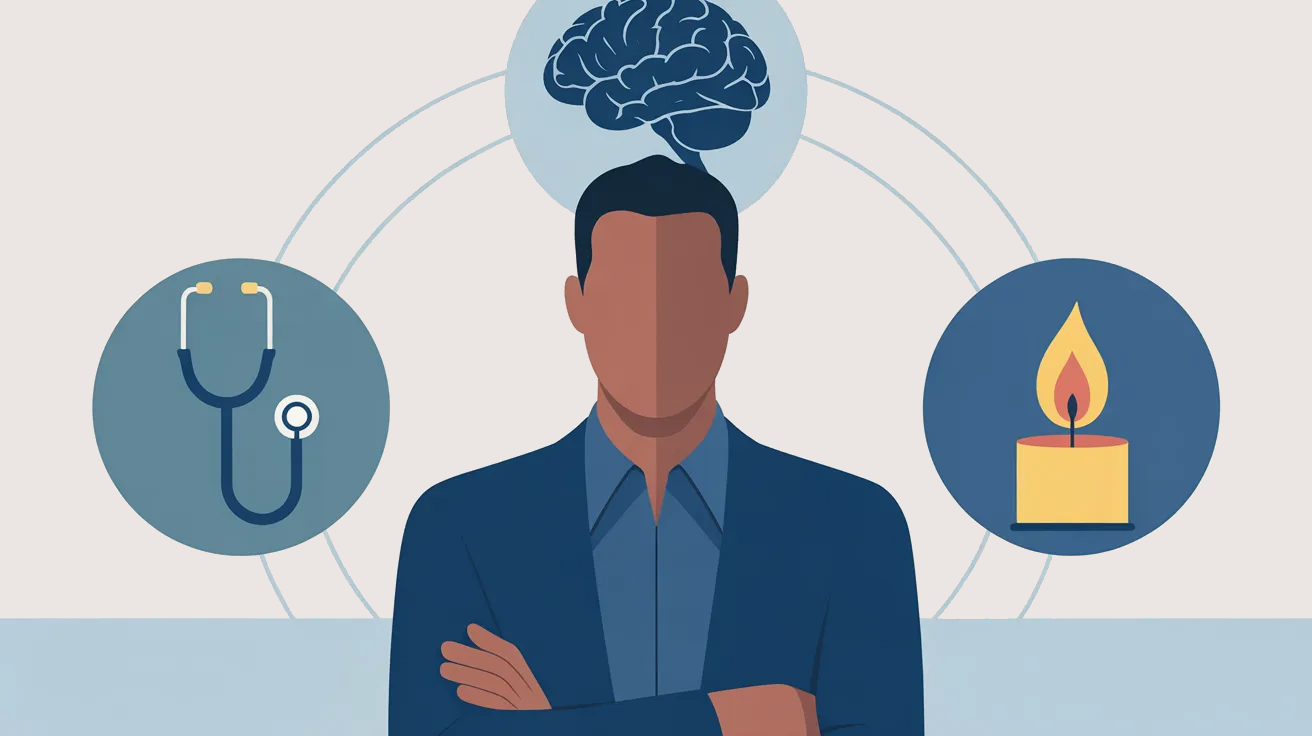
That was the first time I realized something that has shaped how I think about my health ever since: my body, my mind, and my spirit weren’t separate systems. They were one system. And no single professional—no matter how skilled—could see all of it at once.
Two decades later, I finally found one that could.
CEOs are brilliant at orchestrating every part of their business. Then they walk into a doctor’s office and become passive. That’s where CEO self-care breaks down.
Here’s why it matters. Being a CEO is like being a professional athlete. The role is demanding and relentless—and you can’t compete unless your body, your mind, and your spirit are in tip-top shape. If you don’t manage your health proactively, it will eventually fail you, and it will take your work down with it.
The moment you stop outsourcing your health and start running it the way you run everything else, everything changes. Here are three moves that put you back in charge.
Move #1: Own Your Physical Health
Here’s the standard pattern. You get blood labs back in a portal. A wall of abbreviations. Reference ranges you can’t decode. Then you drive to your doctor’s office, wait thirty minutes in the lobby, and sit across from her for the median fifteen-minute primary care appointment.1 You walk out having understood maybe half of what she said.
In June of 2024, I decided I was done with that. I built a self-care project in Claude and loaded it with my medical history, my published books, and a clear instruction set. The first thing I did was paste in my latest blood labs—I run them three times a year—and ask for a plain-English briefing.
What came back stopped me cold. Every value explained in language I could actually understand. Patterns flagged that my doctor and I hadn’t discussed. A ranked list of specific, pointed questions to bring to my next appointment.
Then I went further. I pulled my raw data from 23andMe, fed it into the project, and asked for a full functional genomic health report. My primary care physician—who is a functional medicine doctor—reviewed it with me at our next visit. It shaped every decision we made about my supplements, labs, and monitoring plan for the year.
Your physician’s job is not to educate you. It’s to diagnose and treat you. Your job is to walk in prepared—like the CEO of your own health. AI for personal health is the research assistant that finally makes that possible.
Move #2: Own Your Mental Health
This is where most CEOs are stuck. And it’s the move I was most skeptical about.
Mental health isn’t just how you feel. It’s how your nervous system regulates under load, how you manage the stories you tell yourself, and whether you can spot the limiting beliefs that quietly run your decisions. For CEOs, the stakes are higher than for almost anyone else—because everyone around you is affected by how regulated you are.
I’d been in therapy off and on for decades. I’d worked with gifted clinicians. Every one of them was excellent. And somehow, I kept bumping into the same patterns—the same restless inability to focus on long blocks of deep work, the same scatter, the same vague sense that something was miscalibrated in how my brain ran.
Last year, on a hunch, I ran myself through an adult ADHD screening inside my self-care project. I answered every question as honestly as I could. The output surprised me. It suggested I likely had adult ADHD—and handed me a specific list of diagnostic questions to bring to my therapist and my primary care physician.
I brought both lists to both professionals. They confirmed the diagnosis. I started medication and life has been dramatically better since.
Here’s the part I want you to catch. Adult ADHD is not rare. The CDC reports that 15.5 million U.S. adults—6 percent of the adult population—have a current diagnosis, and more than half of them were diagnosed in adulthood.2 I spent decades with good professionals who missed it, not because they weren’t skilled, but because they each saw a slice of me. The AI saw the whole picture.
If you’ve been quietly wondering whether something is off—undiagnosed anxiety, burnout, ADHD, a limiting belief you can’t quite name—AI cannot diagnose you. But it can help you name the pattern and walk into your therapist’s office with the right questions.
Move #3: Own Your Spiritual Health
This is the move most CEOs skip. Not because they don’t care, but because they don’t know how to approach it without feeling like they’re doing it wrong.
Spiritual questions are humbling. They rarely have clean answers. And the professionals who help us navigate them—pastors, priests, spiritual directors—are often the hardest to access. You might see your cardiologist three times a year. You might see your spiritual director three times a decade.
AI doesn’t replace that relationship. It gives you a place to think out loud between appointments. I use my self-care project to work through questions I’m wrestling with in my Eastern Orthodox Christian tradition—prayer, suffering, vocation, forgiveness. I load it with the writings I trust and ask for related passages, historical context, and perspectives from teachers across my tradition.
The goal isn’t to replace your spiritual director. The goal is to show up to your next appointment with the questions you’ve actually been carrying, in the language they deserve.
The New Normal
Imagine walking into your next doctor’s appointment with a briefing on your own labs, a ranked list of questions, and a clear sense of what you want to decide before you leave. Imagine knowing what’s actually going on in your mind—not vaguely wondering. Imagine your spiritual life catching up to the rest of your life.
None of that requires you to become a doctor, a therapist, or a monk. It requires CEO self-care across every dimension—body, mind, and spirit—and using AI the way you’d use any other strategic tool. As a force multiplier. A synthesizer. A thinking partner that sees the whole picture when your specialists can’t.
Twenty years ago, that cardiologist took me seriously, and I took him seriously too. I changed my diet. I started exercising. I went to the Vanderbilt Executive Health Center every year for a full physical. It worked for what we could see.
What we couldn’t see was the slow calcium buildup in my arteries—driven by a genetic condition called LP(a) that wouldn’t be identified for another twenty years. I had a mild heart attack and quadruple bypass in 2022. Every cardiologist I worked with told me the same thing: the only reason I survived was because I’d spent two decades getting my body in shape.
What I wish I’d had in 2003 is the tool I have now. Not to replace my cardiologist, my primary care physician, or my functional medicine team—but to help me see the patterns across all of them, sooner. You don’t have to wait.
Which of the three moves will you make first—and what’s stopping you from starting it this week?
Comments
If you have a question about using AI to equip you to take charge of your own health, click here to send me an email. I read every one. Seriously. Your experiences help me write better content, and sometimes the best insights come from readers like you.
Transforming AI from noise to know-how,

P.S. Consider the AI Business Lab Mastermind: Running a $3M+ business? You’re past the startup chaos but not quite at autopilot. That’s exactly where AI changes everything. The AI Business Lab Mastermind isn’t another networking group—it’s a brain trust of leaders who are already implementing, not just ideating. We’re talking real numbers, real strategies, real results. If you’re tired of being the smartest person in the room, this is your new room. 👉🏼Learn more and apply here.
REFERENCE
- Ming Tai-Seale, Thomas G. McGuire, and Weimin Zhang, “Time Allocation in Primary Care Office Visits,” Health Services Research 42, no. 5 (October 2007): 1871–1894. ↩︎
- Brooke S. Staley et al., “Attention-Deficit/Hyperactivity Disorder Diagnosis, Treatment, and Telehealth Use in Adults — National Center for Health Statistics Rapid Surveys System, United States, October–November 2023,” MMWR Morbidity and Mortality Weekly Report 73, no. 40 (October 10, 2024): 890–895. ↩︎